Tianyi Sensor IOT Technology Co., Ltd
Sales Manager:Ms. Emily Wang
Cel,Whatsapp,Wechat:+86 15898932201
Email:info@fengtutec.com
Add:No. 155 Optoelectronic Industry Accelerator, Gaoxin District, Weifang, Shandong, China


Sales Manager:Ms. Emily Wang
Cel,Whatsapp,Wechat:+86 15898932201
Email:info@fengtutec.com
Add:No. 155 Optoelectronic Industry Accelerator, Gaoxin District, Weifang, Shandong, China
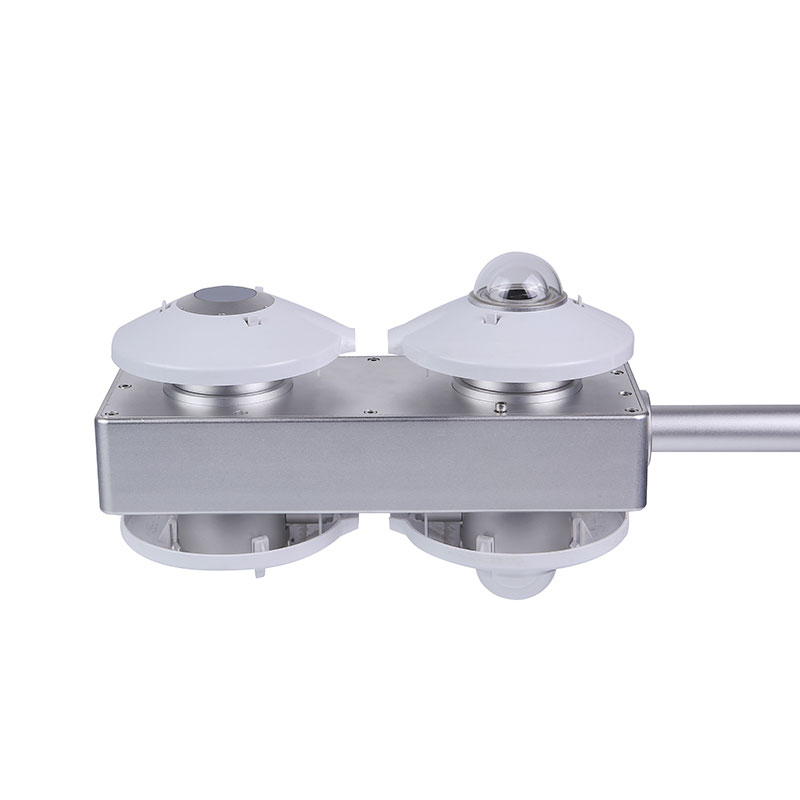
Model:FT-FS7H
Brand:tianyi
1.4-Component Net Radiometer Product Overview
4-Component Net Radiometer measures the energy balance between incoming shortwave and longwave infrared radiation and the shortwave reflected by surfaces.In meteorological applications, infrared radiation or long-wave radiation refers to electromagnetic radiation with a wavelength greater than 3.0 μm.Long-wave radiation is physically related to temperature and all objects on Earth emit long-wave radiation.The spectral range of the sun's short-wave radiation is 300nm to 3μm (accounting for 99.5% of the total solar radiation energy).
Fengtu's FT-FS7H four-component net radiation sensor directly measures the daily long-wave radiation and short-wave radiation and calculates the net radiation.Meteorological observations for atmospheric radiation (radiation emitted by clouds/water vapor and carbon dioxide, etc.) and net radiation exchange between the earth and the atmosphere.The net total radiation (short wave + long wave) is usually measured by 4 net radiation meters or a single net radiation meters (the detector can respond to the full band).The Earth's long-wave radiation meter uses a hemisphere-facing detector to measure the long-wave radiation emitted downward.Net long-wave radiation and downward emission radiation from the ground gas system can be calculated.It has been widely used in the fields of meteorology/photovoltaics/horticulture/agriculture and industry.
2.4-Component Net Radiometer product features
1.Comply with the WMO World Meteorological Organization Code (CIMO Guide)
2.Strong sensitivity to infrared radiation with wavelengths of 4 to 50 µm
3.The impact of the silicon hood has small impact on heating
4.Small cosine response error
5.Reduce environmental impact
6.Have good stability
3.4-Component Net Radiometer Technical Indicators
| Technical parameters | Technical Note |
| Total radiation | |
| Level standard | FIRST CLASS |
| Time response (95%) | 13s |
| Heat radiation zero point offset | ±10W/m2 |
| Temperature change zero point offset | ±3W/m2 |
| Nonlinear | ±1.5% |
| Instability | ±1% |
| Directive response | ±18 W/m2 |
| Spectral Error | ±3% |
| Temperature response (-10~40℃) | 3% |
| Inclination error | ±1% |
| Spectral response | 285~3000nm |
| Daily extraction accuracy | <5% |
| Resolution | 1W/m2 |
| Sensitivity | 7~14μV/W•m-2 |
| Signal output | 0~20mV |
| Earth's Radiation | |
| Spectral response | 400~50000nm |
| Response time (sec) 95% | <18s |
| Instability (change/year) | <2 % |
| Temperature coefficient | ≤±1%(-20℃~+50℃) |
| Perspective | 180° |
| Sensitivity (µV/W/m²) | 2~150uV/ Wm-2 |
| Impedance (Ω) | 20~140 |
| Window heating offset | <4W/m2 (When solar radiation is 1000W/m2) |
| Signal range | -500~+500 W/m² |
| Signal output | -20~0mV |
| General parameters | |
| Number of channels | 4-channel mV, 2-channel 4-wire platinum resistor |
| Temperature sensor | Wire type platinum resistor (JIS standard: c-1604-1989 category) |
| Operating temperature | -40~+70℃ |
| weight | 9kg |
High-standard farmland refers to high-yield and stable-yield farmland constructed through land consolidation, soil improvement, irrigation system development, and other measures. The key lies in "precision management" and "efficient output." Compared to ordinary farmland, high-st...
Throughout the long history of human interaction with the natural environment, weather has always held a pivotal position. Since ancient times, people have sought to uncover the mysteries of weather changes to better arrange their lives and production activities. In ancient times, people accumulated...
I. Product IntroductionOur company is a professional manufacturer of meteorological sensors. We have been focusing on the research and development, as well as the production of various meteorological sensors, and also provide meteorological environment solutions. The company has a complete productio...
How to solve the problems of water pollution and water quality deterioration? Traditional manual sampling is time-consuming and lagging, but now there is a more efficient solution - the Water Quality Monitoring Buoy!As a key piece of equipment for water environment monitoring, its development precis...


 Get a Free Quote
 Skype
Skype
 whatsapp
 mail
mail