Tianyi Sensor IOT Technology Co., Ltd
Sales Manager:Ms. Emily Wang
Cel,Whatsapp,Wechat:+86 15898932201
Email:info@fengtutec.com
Add:No. 155 Optoelectronic Industry Accelerator, Gaoxin District, Weifang, Shandong, China


Sales Manager:Ms. Emily Wang
Cel,Whatsapp,Wechat:+86 15898932201
Email:info@fengtutec.com
Add:No. 155 Optoelectronic Industry Accelerator, Gaoxin District, Weifang, Shandong, China

Model:FT-G1
Brand:tianyi
1.Introduction to Optical Rain Gauge Products
Optical Rain Gauge is based on the principle of photoelectric detection and is mainly used to measure rainfall. It is a reliable and cost-effective choice for precipitation measurement.Optical Rain Gauge uses three-channel narrowband infrared detectors and pure sinusoidal AC signal source.It has the advantages of high accuracy, strong ambient light resistance, maintenance-free, and compatible with other optical sensors (light, ultraviolet radiation, total radiation).It can be widely used in meteorological, agricultural, municipal, transportation and other industries.The sensor is designed with a low power consumption and can be used in unattended observation stations in the field.
2.Optical Rain Gauge product features
Optical Rain Gauge uses a pure sinusoidal infrared light source, a built-in narrowband filter, and a rain-sensitive surface of 78 square centimeters.It can measure rainfall with high accuracy and be free from high-intensity sunlight and other lights.The high light transmittance rain cover does not affect direct sunlight and is compatible with other built-in optical sensors, such as light, total radiation, ultraviolet sensors, etc.(Invention Patent, Patent No.ZL 2022 1 1306149.3)
3.Optical Rain Gauge technical parameters
1.Supply voltage: DC12V
2.Sensor power consumption: 0.12W
3.Current: 10ma DC12V
4.Rainfall resolution: 0.01mm
5.Rain intensity range: 0-4mm/min
6.Measurement accuracy: ≤±4%
7.Working environment: -40~85℃, 0~100%RH
4.Optical Rain Gauge product size diagram
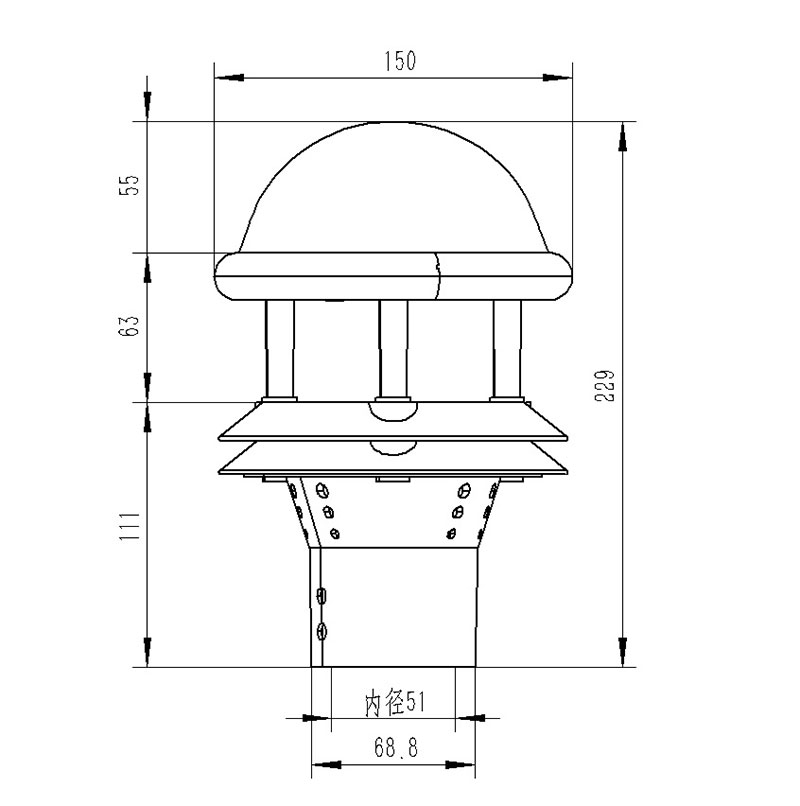
5.Precautions for Optical Rain Gauge
1.The radius of 1 meter around the sensor level is not blocked to avoid the influence of water droplets.
2.The above sensor installation position should avoid obstruction of trees, and the oblique direction should also avoid obstruction of shade.
3.To ensure measurement accuracy, the sensor should be installed horizontally
Modern agriculture is transitioning from extensive management to precision agriculture and smart agriculture. Data-driven decision-making is employed to achieve the goals of water conservation, fertilizer reduction, pesticide reduction, yield increase, and quality improvement. Meteorological data is...
The Piezoelectric rain gauge sensor utilizes a PVDF piezoelectric film as the core rain-sensing component, combined with an embedded AI neural network algorithm to differentiate raindrop signals. This sensor is used for remotely measuring precipitation amount, precipitation intensity, and prec...
Stainless Steel Tipping Bucket Rain Gauge employs a standard Φ200mm diameter aperture and a bistable tipping bucket structure. Each bucket triggers tipping when it receives 0.2mm of rainfall. It supports Modbus 485 signal output and ±2% measurement error, making it suitable for monitoring li...
What kinds of Wind Speed Sensors are there on the market and how should consumers choose?There are a wide variety of Wind Speed Sensors available in the market. However, according to the detection principles, they can be classified into mechanical sensors, ultrasonic sensors, thermal sensors, Pitot...


 Get a Free Quote
 Skype
Skype
 whatsapp
 mail
mail