Tianyi Sensor IOT Technology Co., Ltd
Sales Manager:Ms. Emily Wang
Cel,Whatsapp,Wechat:+86 15898932201
Email:info@fengtutec.com
Add:No. 155 Optoelectronic Industry Accelerator, Gaoxin District, Weifang, Shandong, China


Sales Manager:Ms. Emily Wang
Cel,Whatsapp,Wechat:+86 15898932201
Email:info@fengtutec.com
Add:No. 155 Optoelectronic Industry Accelerator, Gaoxin District, Weifang, Shandong, China

Model:FT-L1S1
Brand:tianyi
1.Doppler Flow Meter product principle
Doppler Flow Meter is an ultrasonic flow meter that measures the velocity of a fluid and is ideal for monitoring flow in canals, culverts, pipes and natural streams.In the field of acoustics, when there is relative movement between the sound source and the receiver (i.e., the probe and the reflector), the frequency of the echo will change.This frequency change is called frequency shift, that is, the Doppler effect.The frequency of the sound wave becomes higher when moving towards the observer and lower when moving away from the observer.Doppler Flow Meter calculates the flow rate by calculating frequency changes.
2.Doppler Flow Meter technical parameters
1.Power supply: DC10-15V
2.Working current: 80-180mA 12V
3.Sound wave frequency: 2MHZ
4.Blind spot: 6.5-7 cm (the water level is lower than the blind spot measurement data has low accuracy)
5.Flow rate range: 0m~+6m/s,
6.Accuracy: ±1.0%±1cm/s
7.Water level: Range: 0.03m~5m (customizable 10m), accuracy: 0.3%±0.5cm
8.Water temperature: range: -10℃~60℃, accuracy: ±1℃
9.Instantaneous flow range: 0~99.99m³/s
10.Cumulative flow range: 0.1m³~99999m³
3.Doppler Flow Meter installation instructions
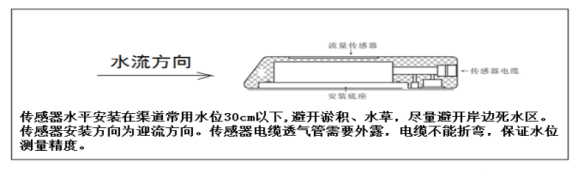
Normal installation ensures 20CM below the minimum water level to avoid exposing the water
Sensor installation diagram:
4.Doppler Flow Meter Notes
1.The sensor needs to avoid silt and collisions of objects such as gravels.Where there are many aquatic plants, grilles need to be installed to prevent aquatic plants from entangling.
2.Sensor installation direction, the sensor transmission surface needs to be installed in the flow direction.
3.The sensor has a sound wave blind spot.Try to ensure that the sensor is below 20 cm underwater (the sensor is semi-exposed under water or blocked by sludge may appear false data, with very low probability.Usually, the data will appear large numbers such as more than 2 meters/second.It is recommended that secondary developers use sensors to block the large flow rate value by the water level, or the water flow rate is not that large in actual application scenarios, which can directly block the flow rate greater than 2 meters or more).
4.The cable vent pipe is not difficult to break, affecting the water level measurement.
5.Try to do a good job in signal and power lightning protection.
6.If the sensor cable is connected to a length, you need to add a 485 relay, and the power supply avoids the interference of the inverter.
Compared with traditional embedded sensors, the Road Condition Sensor has obvious advantages in practical applications. It adopts non-intrusive installation, which does not require damaging the road structure. The installation process is simple and convenient, which can greatly reduce the impact of...
The buoy-type online water quality monitoring system is a modern water body monitoring method. As an automated device for long-term and real-time monitoring of water quality, it is widely used in environmental monitoring of various water areas such as rivers, lakes, oceans, reservoirs, and aquacultu...
Infrared Thermal Imaging Camera is an electronic instrument based on the principle of infrared radiation detection, It receives infrared radiation energy emitted from the surface of an object in a non-contact manner and converts it into a visible thermal image to reflect the temperature distribution of the target. This device supports multiple display and analysis modes....
How to solve the problems of water pollution and water quality deterioration? Traditional manual sampling is time-consuming and lagging, but now there is a more efficient solution - the Water Quality Monitoring Buoy!As a key piece of equipment for water environment monitoring, its development precis...


 Get a Free Quote
 Skype
Skype
 whatsapp
 mail
mail