Tianyi Sensor IOT Technology Co., Ltd
Sales Manager:Ms. Emily Wang
Cel,Whatsapp,Wechat:+86 15898932201
Email:info@fengtutec.com
Add:No. 155 Optoelectronic Industry Accelerator, Gaoxin District, Weifang, Shandong, China


Sales Manager:Ms. Emily Wang
Cel,Whatsapp,Wechat:+86 15898932201
Email:info@fengtutec.com
Add:No. 155 Optoelectronic Industry Accelerator, Gaoxin District, Weifang, Shandong, China
time:2026-06-03 14:00:22 source:Weather Station viewed:5 time
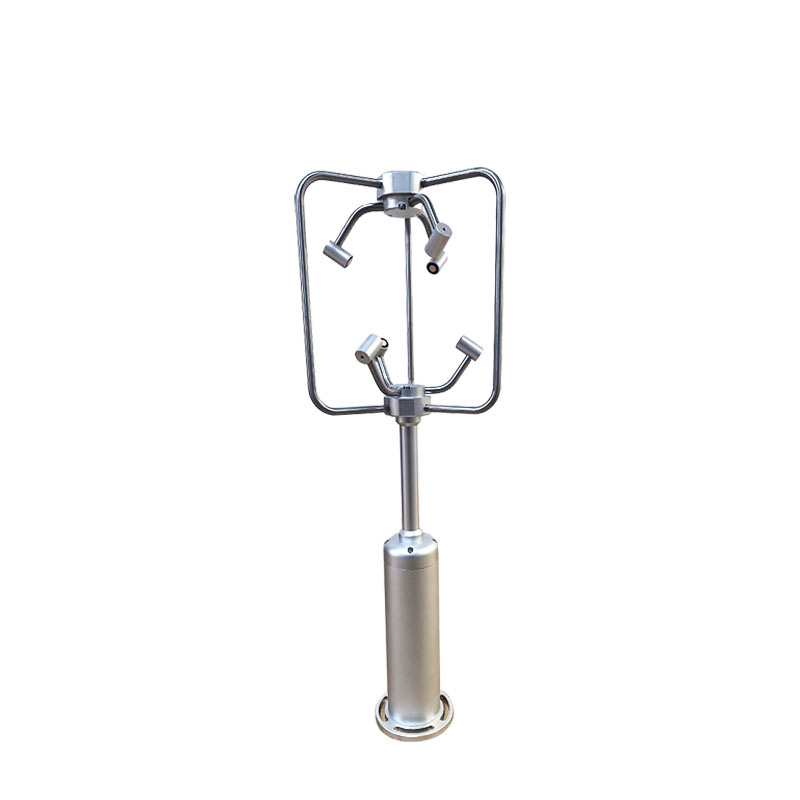
Shandong Fengtu offers three 3D ultrasonic anemometers: the FT-SWF1 aluminum alloy model (16,000 yuan), the FT-SWF2 stainless steel model (18,000 yuan), and the FT-F1H drone model (8,800 yuan). All models utilize the ultrasonic time-of-flight method, have no mechanical rotating parts, and measure the U, V, and W three-dimensional wind speed vectors. They are widely used in meteorological research, wind power generation, bridge monitoring, and drone high-altitude measurements.
The 3D ultrasonic anemometers produced by Shandong Fengtu IoT Technology Co., Ltd. operate based on the ultrasonic time-of-flight method. Inside the device, three pairs of ultrasonic transducers are arranged along the X, Y, and Z orthogonal axes. Each pair of transducers alternately emits and receives ultrasonic pulses. When airflow moves along a certain axis, the ultrasonic waves propagating with the wind accelerate, while those propagating against the wind slow down. By measuring the time difference in propagation in the two directions using a high-precision timing circuit, the wind speed component along that axis can be calculated. The component data from the three axes are synthesized to obtain a three-dimensional spatial wind speed vector, which is then used to calculate the horizontal and vertical wind direction angles. The entire measurement process involves no rotating mechanical parts, thus achieving zero-speed start-up and eliminating the start-up wind speed limitations, rotational inertia, and mechanical wear problems inherent in traditional mechanical anemometers. The equipment can operate stably within a temperature range of -40℃ to 80℃, with a maximum protection rating of IP66, making it adaptable to harsh environments such as rain, snow, dust storms, high humidity, and salt spray.
Shandong Fengtu offers three models for different application scenarios. The FT-SWF1 aluminum alloy model, priced at 16,000 yuan, features a lightweight, compact, and aesthetically pleasing aluminum alloy casing, making it suitable for common outdoor applications such as wind power generation, road and bridge meteorological monitoring, environmental monitoring, and urban meteorological stations. Wind speed measurement range: 0-70 m/s, accuracy ±0.5 m/s; wind direction measurement range: 0-360 degrees, accuracy ±2 degrees; vertical wind direction measurement range: -90 degrees to +90 degrees. The output interface is RS485, and the communication protocol uses the standard MODBUS protocol. It operates on 9 to 24 volt DC power, with an average power consumption of approximately 2 watts.
The FT-SWF2 stainless steel version is priced at 18,000 yuan. Its stainless steel shell offers enhanced corrosion resistance and salt spray resistance, achieving an IP66 protection rating. It is particularly suitable for high-humidity, high-salt-spray environments such as coastal areas, marine vessels, offshore wind power, and ports. Its technical parameters are basically the same as the aluminum alloy version, but it boasts higher structural strength and superior reliability for long-term outdoor deployment.
The FT-F1H drone version is priced at 8,800 yuan and features a miniaturized design specifically for drone systems. Weighing only 114 grams and with a measurement path length of only 35 millimeters, its compact size does not increase the drone's load. Wind speed measurement range is 0-50 meters per second with an accuracy of ±2%; wind direction measurement range is 0-359 degrees (U and V axes) and ±60 degrees (W axis). The output interface can be selected from RS232 or RS485, the operating temperature is -40 to 70℃, and the protection rating is IP65. When mounted on a drone, this device can perform 3D wind field measurements in areas inaccessible to personnel, such as high altitudes, canyons, and volcanic craters, providing aerial wind field data for meteorological research, wind resource assessment, and environmental pollution diffusion analysis.
The common advantages of the three 3D ultrasonic anemometers are no mechanical wear, lifetime maintenance-free operation, and no need for on-site calibration. Users can choose the appropriate model based on the deployment environment, budget, and vehicle requirements to achieve full-scene 3D wind field monitoring from fixed ground stations to mobile drone platforms.
Negative oxygen ion monitoring stations collect real - time data on negative oxygen ion concentrations in the environment through sensors, and transmit the data to the background for processing and display via communication technologies. The core of this system lies in its precise perception of the...
Vehicle-mounted weather instrument is a high-precision meteorological monitoring device designed for mobile platforms such as vehicles and ships. It can measure environmental temperature, relative humidity, wind speed, wind direction, atmospheric pressure, and piezoelectric rainfall data in real time....
Negative oxygen ion powder is a special material added to spray paints, mainly composed of natural mineral powders such as tourmaline powder. Tourmaline has pyroelectric and piezoelectric properties: when subjected to temperature or pressure changes, an electric potential difference is generated bet...
In the road structure system, from top to bottom are the surface course (with a thickness of about 15 centimeters), the base course (with a thickness of about 30 centimeters), the cushion course (with a thickness of about 25 centimeters), and the subgrade. The highway subgrade can encounter problems...


 Skype
Skype
 whatsapp
 mail
mail