Tianyi Sensor IOT Technology Co., Ltd
Sales Manager:Ms. Emily Wang
Cel,Whatsapp,Wechat:+86 15898932201
Email:info@fengtutec.com
Add:No. 155 Optoelectronic Industry Accelerator, Gaoxin District, Weifang, Shandong, China


Sales Manager:Ms. Emily Wang
Cel,Whatsapp,Wechat:+86 15898932201
Email:info@fengtutec.com
Add:No. 155 Optoelectronic Industry Accelerator, Gaoxin District, Weifang, Shandong, China
time:2025-06-25 08:48:32 source:Weather Station viewed:369 time
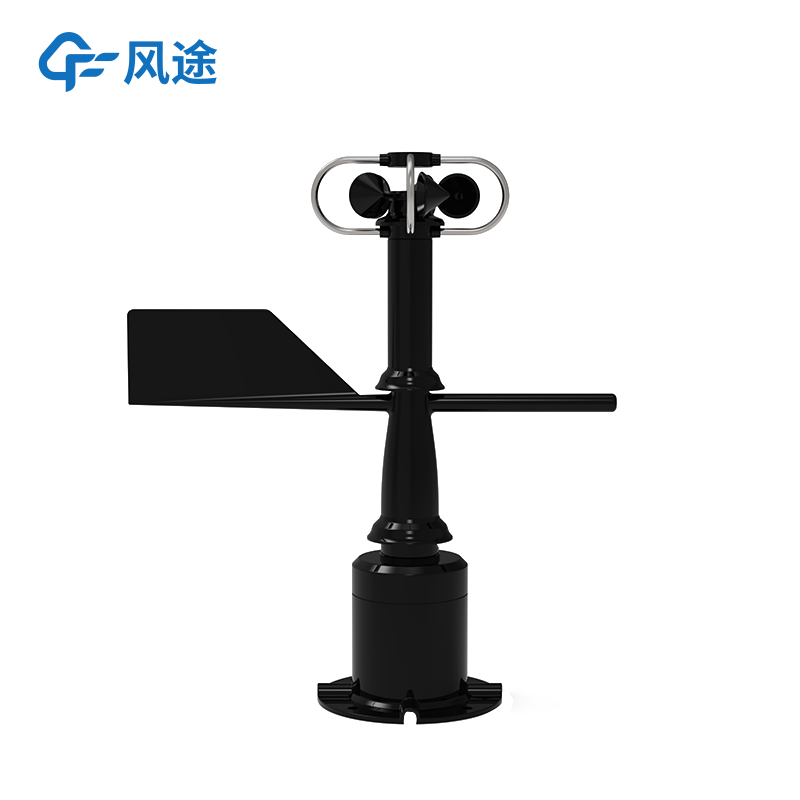
When it comes to anemometers, the most classic Mechanical anemometer immediately comes to mind. It realizes the measurement of wind speed and direction through mechanical structures and physical principles, and its classic nature stems from a mature technical system and extensive application practices.
In terms of structure, the sensor consists of two parts: a wind speed measurement unit and a wind direction measurement unit.
The wind speed measurement unit uses a cup or propeller structure. The cup-type wind speed sensor is composed of 3-4 hemispherical or parabolic cups, which are installed on a rotating shaft perpendicular to the air flow at a uniform angle. When the air flow passes through, the cups generate a rotational speed due to the difference in aerodynamic forces on the windward and leeward sides, and the rotational speed is linearly related to the wind speed. By installing a photoelectric encoder or magnetic induction element on the rotating shaft, the mechanical rotational speed is converted into an electrical signal, which is processed by the circuit to obtain an accurate wind speed value. The propeller-type wind speed sensor relies on the rotation of the propeller blades in the wind and uses a similar principle to achieve wind speed measurement, with the advantage of being more sensitive to low wind speed changes.
The wind direction measurement unit usually uses a wind vane structure. The wind vane is designed in an asymmetrical shape, with the center of gravity offset from the rotation axis, so that it can automatically align with the wind direction under the action of the air flow. The tail of the wind vane is connected to a potentiometer or angle sensor. When the wind vane rotates with the wind direction, it drives the sensor to output a corresponding electrical signal, and the wind direction angle can be determined by analyzing the electrical signal, which is generally expressed in 16 azimuths or 360° full angles.
The above mechanical structure is simple and intuitive. After long-term verification, it has high reliability, and the measurement accuracy meets the needs of most conventional meteorological monitoring and industrial applications. Moreover, it is convenient to maintain, and the performance can be restored by replacing the worn parts. However, it also has limitations. The mechanical rotating parts are easily affected by environmental factors such as sand and dust and freezing, resulting in measurement errors, and the response speed is relatively slow, which is not suitable for the measurement of rapidly changing turbulent environments.
In practical applications, Mechanical anemometers are widely used in meteorological stations, airports, ports, wind power plants and other places. Meteorological stations use wind speed and direction data for weather forecasting and climate research; airports and ports rely on it to monitor environmental wind speed and direction to ensure the safety of aircraft takeoff and landing and ship navigation; wind power plants optimize the operating angle of fans through measurement results to improve power generation efficiency.
Although new anemometry technologies such as ultrasonic and laser are emerging, Mechanical anemometers still rely on the advantage of low cost and remain classic instruments that must be purchased in the field of basic anemometry.
In underground coal mine operations, ensuring the safety of personnel and the smooth progress of work is of great significance. The industrial product, the Toxic gas detector, as a safety detection device, shoulders the important responsibility of safeguarding the safety of the mine. It can accurate...
Smart weather station is a highly integrated, low-power, and rapidly deployable automatic meteorological observation device. It can perform real-time and precise monitoring of wind speed, wind direction, temperature, humidity, atmospheric pressure, PM2.5, PM10, and noise, and features IoT clou...
Traditional flow measurement involves trekking through mountains and rivers, enduring sun and rain, while modern technology can achieve fully automatic monitoring with just one device.River flow measurement is a crucial part of water conservancy work, directly related to flood control, drought relie...
The standout advantage of the Portable Weather Station is its "portability," a feature directly reflected in its name. Compared with traditional fixed meteorological monitoring equipment, it has a significantly smaller size and lighter weight, with its overall design fully considering the...


 Skype
Skype
 whatsapp
 mail
mail