Tianyi Sensor IOT Technology Co., Ltd
Sales Manager:Ms. Emily Wang
Cel,Whatsapp,Wechat:+86 15898932201
Email:info@fengtutec.com
Add:No. 155 Optoelectronic Industry Accelerator, Gaoxin District, Weifang, Shandong, China


Sales Manager:Ms. Emily Wang
Cel,Whatsapp,Wechat:+86 15898932201
Email:info@fengtutec.com
Add:No. 155 Optoelectronic Industry Accelerator, Gaoxin District, Weifang, Shandong, China
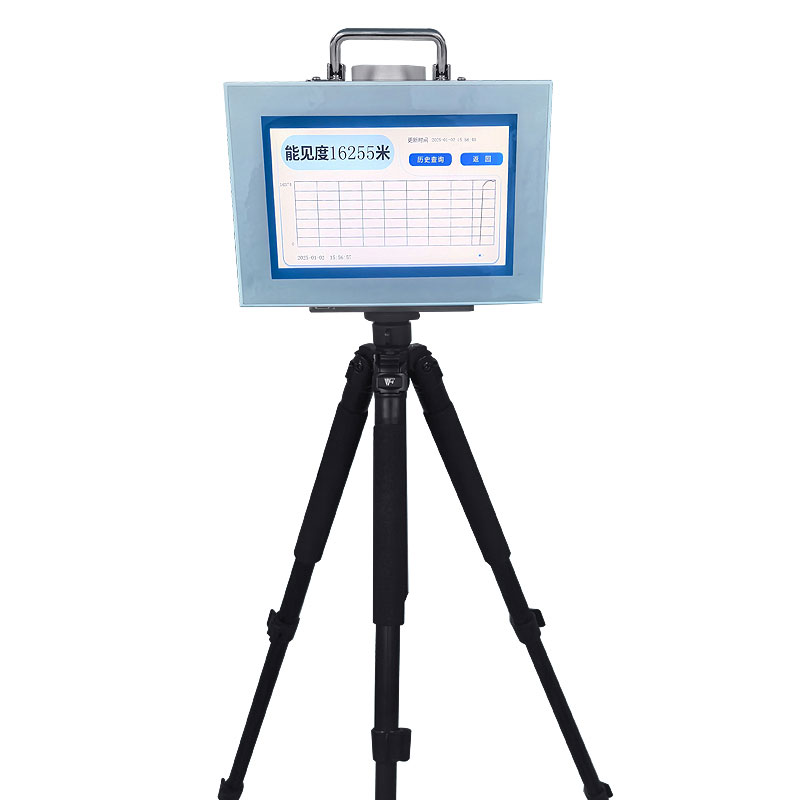
Model:FT-BN10
Brand:tianyi
1、Portable visibility Sensor Product Introduction
Portable visibility Sensor measures atmospheric visibility (meteorological optical range),The device is portable and widely used in road, ocean, aviation and wind energy.BN10 Portable visibility Sensor uses the forward scattering method to measure the total extinction coefficient of air and calculate current visibility.It is widely used in emergency response, road traffic, and meteorological scenarios.
2、Portable visibility Sensor Technical Features
1.Integrated portable design, lightweight, easy to carry, and ready to use immediately;
2.10.1-inch high-brightness touchscreen displays real-time data and historical curves;
3.Built-in large-capacity SD card (8GB) for real-time data storage, query support, and export support;
4.Built-in large-capacity lithium battery for convenient outdoor emergency use;
5.The instrument's housing is made of high-quality aluminum, offering excellent waterproof, dustproof, and impact resistance;
6.Built-in watchdog circuit ensures reliable and stable operation for extended periods of outdoor operation;
7.The instrument's communication and power ports are both lightning-proof, minimizing damage from lightning strikes and static electricity;
8.24V power supply, low power consumption, and long-term power supply;
9.The digital interface uses RS232 for active upload, requiring no protocol adaptation.
3、Portable visibility Sensor Implementation Standards
QX/T 536-2020 Test Method for Forward Scatter Visibility Meters
4、Portable visibility Sensor Technical Parameters
| Main parameters | Parameter range | Resolution | Error | |
| Range | BN10 | 10km☆ | 1m | ≤2km ±2%; 2km~10km ±5%; >10km ±10% |
| BN20 | 20km☆ | |||
| Repeatability | ≤4% | |||
| Working temperature | -20~60℃ | |||
| Working humidity | 0~100%RH | |||
| Work power (adapter) | 100-240V input; 24V output; 2.5A | |||
| Power consumption | <10W | |||
| Battery capacity | 6.6AH | |||
| Working hours | ≥12h | |||
| Size | 300x150x220mm(length x width x height) | |||
| Weight | ≤10kg | |||
In the photovoltaic industry, requirements for module quality and reliability are becoming increasingly stringent. Traditional inspection methods cannot effectively identify internal defects, making EL (Electroluminescence) defect detection technology an indispensable quality control tool in photovo...
This fully automated online hydrological monitoring device, based on K-band planar radar technology, can simultaneously measure water level, flow velocity, flow rate, and rainfall. Employing a non-contact measurement method, it is unaffected by silt and sewage corrosion. Its built-in intellige...
Water quality monitoring equipment for water treatment plants is an integrated system for online monitoring of key parameters such as residual chlorine, pH, water temperature, turbidity, and conductivity. It provides a basis for multi-dimensional testing of source water, treated water, and network water, and is widely used in full-process water quality safety management from water plants to end-users....
Water quality monitoring is a systematic scientific process designed to assess water conditions, warn of pollution risks, and provide data support for water environment management through real-time monitoring and analysis of various substances in water bodies.Modern water quality monitoring often em...


 Get a Free Quote
 Skype
Skype
 whatsapp
 mail
mail