Tianyi Sensor IOT Technology Co., Ltd
Sales Manager:Ms. Emily Wang
Cel,Whatsapp,Wechat:+86 15898932201
Email:info@fengtutec.com
Add:No. 155 Optoelectronic Industry Accelerator, Gaoxin District, Weifang, Shandong, China


Sales Manager:Ms. Emily Wang
Cel,Whatsapp,Wechat:+86 15898932201
Email:info@fengtutec.com
Add:No. 155 Optoelectronic Industry Accelerator, Gaoxin District, Weifang, Shandong, China
time:2026-04-13 13:31:08 source:Weather Station viewed:138 time
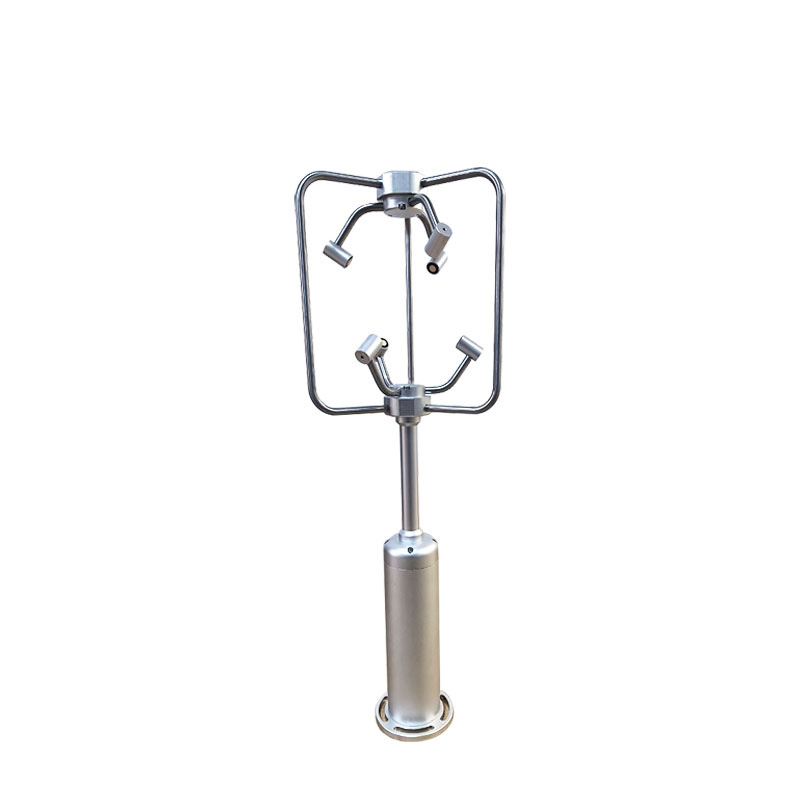
The 3D ultrasonic anemometer utilizes ultrasonic measurement technology and features an all-metal construction devoid of any moving parts; it is capable of simultaneously measuring wind direction in both horizontal and vertical planes while outputting wind speed components along the X, Y, and Z axes. Compact in structure and robust in durability, the device is designed for all-weather operation and finds widespread application in fields such as meteorological monitoring, wind power generation, environmental surveillance, and aviation airports.
The 3D ultrasonic anemometer is a precision meteorological monitoring instrument employing ultrasonic measurement techniques. Its unique structural design significantly minimizes wind resistance effects, thereby enhancing measurement accuracy. The instrument measures wind speed and direction based on the principles of ultrasonic wave propagation; by transmitting and receiving ultrasonic signals, it calculates the three-dimensional components of wind speed and direction based on changes in the speed and trajectory of the sound waves. Compared to traditional mechanical anemometers—which rely on components such as wind cups and wind vanes—the 3D ultrasonic anemometer contains no mechanical moving parts. Consequently, it is immune to mechanical wear and failure, requires no on-site calibration, and offers significantly reduced maintenance costs.
The device is capable of simultaneously measuring wind direction in both horizontal and vertical planes, while outputting wind speed components along the U, V, and W axes. Typically, the instrument consists of three pairs of oppositely mounted ultrasonic transducers, supported by a stainless steel bracket to ensure a tough and sturdy structure. Its all-metal construction endows the device with exceptional resistance to corrosion, salt spray, and wind-blown sand, enabling stable, continuous operation under severe weather conditions—including heavy rain, snow, and frost. In terms of technical specifications, mainstream models typically feature a wind speed measurement range of 0 to 70 m/s, a wind direction range of 0 to 360°, and an elevation angle range of ±60°. With a sampling frequency reaching up to 100 Hz, the device can rapidly capture instantaneous fluctuations in wind speed and direction. Furthermore, the instrument is typically equipped with RS485 or RS232 serial output interfaces and supports the Modbus-RTU communication protocol, allowing for seamless integration into various data acquisition systems and monitoring platforms.
Regarding application fields, the 3D ultrasonic anemometer is widely deployed in scenarios such as meteorological monitoring, wind power generation, urban environmental surveillance, bridge and tunnel management, marine navigation, and aviation airport operations. In the field of meteorology, this device provides accurate wind speed and direction data for weather forecasting and climate research. In wind farm monitoring, the real-time tracking of wind speed and direction variations serves as a vital reference for ensuring the safe operation of wind turbines and optimizing power generation efficiency. In the construction sector, it is utilized for structural wind-load testing and ventilation control systems, aiding in the assessment of the wind environment surrounding buildings. Furthermore, the 3D ultrasonic anemometer serves as an essential measurement tool in various scientific research domains, such as turbulent aerodynamics, surface energy balance, and scalar flux studies. Additionally, select models feature an aluminum alloy or carbon fiber construction with ultra-low power consumption—drawing as little as 55 mA—enabling seamless integration with solar power systems for unattended operation in remote field environments. These units are easy to install, require no mechanical alignment or lubrication, and offer long-term maintenance-free operation, thereby significantly reducing on-site operational and maintenance costs.
Visibility and Present Weather Sensor uses the forward scattering method to measure the total extinction coefficient of air, calculate visibility, and identify weather phenomena such as fog, rain, and snow, with a recognition rate of ≥95%. The casing is made of anodized aluminum, making the e...
As meteorological monitoring needs become increasingly diverse, traditional meteorological equipment faces challenges in installation convenience, data comprehensiveness, and environmental adaptability. Conventional miniature weather instruments often suffer from measurement errors caused by sensor...
Odor online monitor is a professional instrument that utilizes sensor array technology to perform real-time, continuous automatic monitoring of complex odor concentrations and characteristic malodorous gases in the environment. It can quantify and output dimensionless odor concentration OU values an...
What are the negative oxygen ion monitors? One is a detector suitable for scenic spots, and the other is a handheld negative ion detector.For the negative ion detector in scenic spots, the FT-FZ1 Scenic Air Negative Oxygen Ion Monitor can be selected. This monitor can monitor the concentration of ne...



 Skype
Skype
 whatsapp
 mail
mail