Tianyi Sensor IOT Technology Co., Ltd
Sales Manager:Ms. Emily Wang
Cel,Whatsapp,Wechat:+86 15898932201
Email:info@fengtutec.com
Add:No. 155 Optoelectronic Industry Accelerator, Gaoxin District, Weifang, Shandong, China


Sales Manager:Ms. Emily Wang
Cel,Whatsapp,Wechat:+86 15898932201
Email:info@fengtutec.com
Add:No. 155 Optoelectronic Industry Accelerator, Gaoxin District, Weifang, Shandong, China
time:2025-09-28 08:58:33 source:Weather Station viewed:344 time
Before the advent of ultrasonic anemometers, traditional wind speed and direction measurements mainly relied on mechanical sensors.
Cup anemometers calculate wind speed through wind force pushing three or four hemispherical cups to rotate, with rotational speed proportional to wind speed.
Wind vanes, shaped like an arrow with a larger area at the tail, rotate with the wind, always pointing to the wind direction source. They convert angle signals into wind direction readings through potentiometers or encoders.
Due to the presence of mechanical rotating parts, there is delay in starting and stopping, making it impossible to measure instantaneous, high-frequency changing gusts. Moreover, components like bearings are prone to wear, freezing, or damage under long-term operation and harsh weather conditions (such as sandstorms, freezing), leading to inaccurate data or equipment failure requiring frequent maintenance.
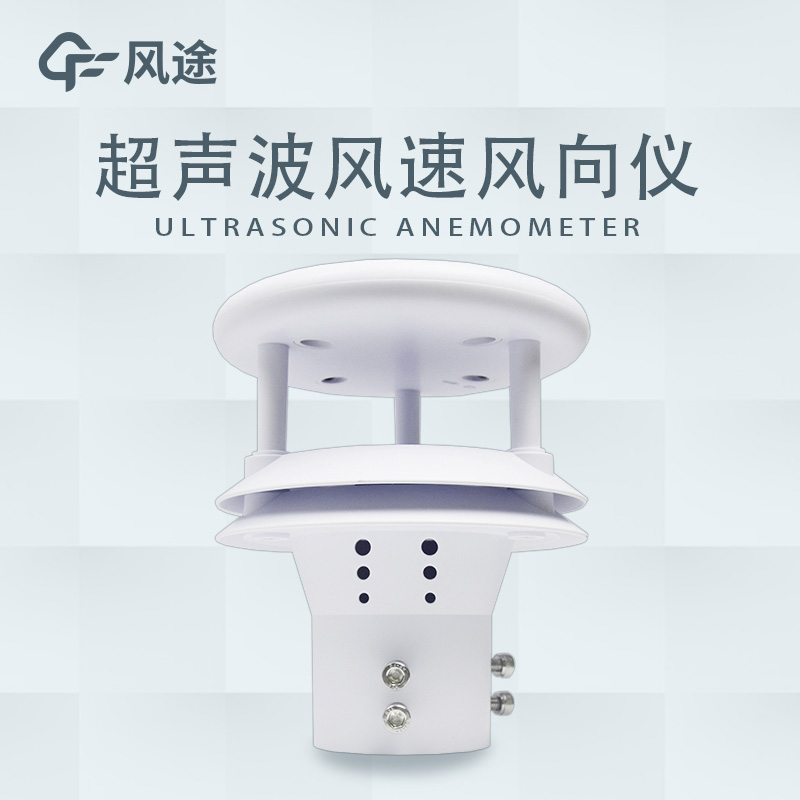
With the growing demand for high-precision, high-frequency, and high-reliability wind field data in meteorological forecasting, aviation safety, environmental monitoring, wind power generation and other fields, a brand new measurement technology without moving parts emerged - this is the Ultrasonic Wind Speed and Direction Sensor.
The Ultrasonic Wind Speed and Direction Sensor is an all-solid-state electronic device that measures wind vectors using the physical principle that the propagation speed of ultrasonic waves in air is affected by wind speed. It has no moving parts, hence also known as a "non-moving part anemometer."
Ultrasonic Wind Speed and Direction Sensors can integrate data recording and wireless transmission (4G/5G, LoRa) functions to achieve remote, networked monitoring. They can also integrate wind speed, wind direction, temperature, humidity, and pressure sensors into one unit, forming a miniature weather station. They are widely used in weather stations, airports, ports and other places for severe weather warning.
Facility agriculture refers to an agricultural form that utilizes new production equipment, modern agricultural engineering technologies, and management techniques to regulate environmental parameter factors such as temperature, light, water, soil, air, and fertilizer for the growth of plants like v...
The operation of air quality monitoring stations relies on a comprehensive grid-based environmental supervision system. This system takes towns, communities (and villages) in cities as basic units, and divides them into air pollution prevention and control management grids according to different lev...
Infrared Thermal Imaging Camera features both infrared and visible light imaging modes, supporting various operating modes including incandescent, black-and-white, firefighting, fire, search and rescue, picture-in-picture, and fusion display, suitable for different on-site environment needs. T...
The Micro water quality station is a highly integrated professional device that combines various functions such as sensor technology, data collection and processing systems, and communication modules. Its working principle is based on the monitoring of various parameters in the water body by differe...


 Skype
Skype
 whatsapp
 mail
mail