Tianyi Sensor IOT Technology Co., Ltd
Sales Manager:Ms. Emily Wang
Cel,Whatsapp,Wechat:+86 15898932201
Email:info@fengtutec.com
Add:No. 155 Optoelectronic Industry Accelerator, Gaoxin District, Weifang, Shandong, China


Sales Manager:Ms. Emily Wang
Cel,Whatsapp,Wechat:+86 15898932201
Email:info@fengtutec.com
Add:No. 155 Optoelectronic Industry Accelerator, Gaoxin District, Weifang, Shandong, China
time:2026-05-26 11:06:05 source:Weather Station viewed:45 time
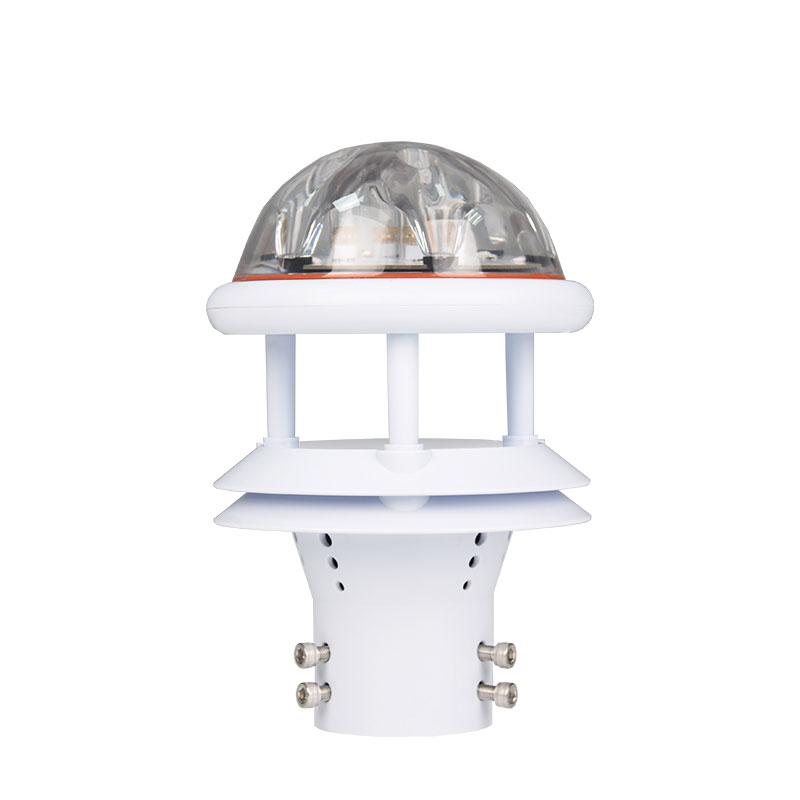
instrument used to measure rainfall employs a three-channel narrowband infrared detector and a pure sinusoidal AC signal source, achieving a rainfall resolution of 0.01mm, a rainfall intensity range of 0-4mm/min, and a measurement accuracy of ≤±4%. The device consumes only 0.12W and operates in ambient temperatures of -40~85℃ and humidity of 0~100%RH. It features maintenance-free operation, resistance to ambient light interference, and compatibility with various optical sensors, including those for light and radiation, making it suitable for unattended field observations in meteorology, agriculture, municipal engineering, and transportation.
instrument used to measure rainfall is a rainfall monitoring device based on infrared optics principles. It achieves high-precision rainfall measurement through a three-channel narrowband infrared detector and a pure sinusoidal AC signal source. Using infrared light as the measurement medium, the device incorporates multiple optical probes, effectively avoiding interference from external light and fog. When raindrops pass through the sensing surface, the beam intensity changes, and the device performs digital signal processing to calculate the real-time rainfall intensity and cumulative amount.
In terms of technical performance, the instrument used to measure rainfall operates on a DC12V power supply, with a sensor power consumption of only 0.12W and a current of 10mA. Rainfall resolution reaches 0.01mm, with a rainfall intensity measurement range of 0 to 4 mm/min and a measurement accuracy of ≤±4%. The device can operate in environments ranging from -40℃ to 85℃ and withstand relative humidity from 0 to 100%RH. The overall protection performance meets the requirements for long-term continuous outdoor operation.
The instrument used to measure rainfall uses a pure sinusoidal infrared light source with a built-in narrowband filter, and its rain-sensing surface reaches 78 square centimeters. The high-transmittance rain-sensing cover does not affect direct sunlight and is compatible with other optical components such as built-in light sensors, total radiation sensors, and ultraviolet sensors, eliminating the need for additional independent optical detection modules. This sensor features a low-power design, making it suitable for unattended field observation stations and widely used in meteorology, agriculture, municipal engineering, transportation, and other industries. The device boasts advantages such as high accuracy, strong resistance to ambient light, and maintenance-free operation, reducing data deviations and maintenance workload caused by mechanical component wear and debris blockage in traditional tipping bucket rain gauges. Compared to traditional mechanical tipping bucket rain gauges, instrument used to measure rainfall contains no moving parts, requiring no mechanical calibration or component replacement for long-term operation, making it particularly suitable for deployment in remote mountainous areas, rooftops, and other locations where frequent manual maintenance is difficult.
Regarding installation, there should be no obstructions within a 1-meter radius around the sensor to prevent water splashes from affecting measurement accuracy. The sensor should be installed above and away from tree shadows to ensure accuracy. The sensor should be installed horizontally. The device features a fully sealed dustproof and waterproof structure with a built-in self-cleaning function to reduce interference from impurities. It supports multi-protocol data transmission and can seamlessly integrate with meteorological monitoring systems. The device supports multi-protocol data transmission and can seamlessly integrate with meteorological monitoring systems, making it suitable for real-time rainfall monitoring in areas such as urban flood control, agricultural irrigation, and traffic meteorology.
The cost of water level monitoring equipment varies based on brand, model, functionality, and measurement precision. Buried-type water level monitoring devices are priced at approximately 4,000 yuan; submersible devices are around 6,000 yuan; and river channel water level monitoring stations c...
The visibility meter uses forward scattering to measure the total extinction coefficient of the air and calculate the current visibility. It has a range of 10km, a resolution of 1m, and an error of ±2% for distances ≤2km, ±5% for distances between 2km and 10km, and ±10% for distances great...
Present weather and visibility sensor is a professional meteorological device used for automatically identifying and observing weather phenomena such as fog, rain, snow, mixed precipitation, and clear skies, and for measuring current visibility. It enables fully automatic and accurate recording of weather type, visibility, and precipitation....
Remote Controlled Lifebuoy is a U-shaped remotely controlled water rescue wing with a control range of up to 1500 meters. It features dual-sided travel, one-button return, automatic righting, and precise positioning, enabling rapid arrival at the location of a person in the water. It is suitable for rescues in complex waters....


 Skype
Skype
 whatsapp
 mail
mail