Tianyi Sensor IOT Technology Co., Ltd
Sales Manager:Ms. Emily Wang
Cel,Whatsapp,Wechat:+86 15898932201
Email:info@fengtutec.com
Add:No. 155 Optoelectronic Industry Accelerator, Gaoxin District, Weifang, Shandong, China


Sales Manager:Ms. Emily Wang
Cel,Whatsapp,Wechat:+86 15898932201
Email:info@fengtutec.com
Add:No. 155 Optoelectronic Industry Accelerator, Gaoxin District, Weifang, Shandong, China
time:2025-12-18 11:07:35 source:Weather Station viewed:392 time
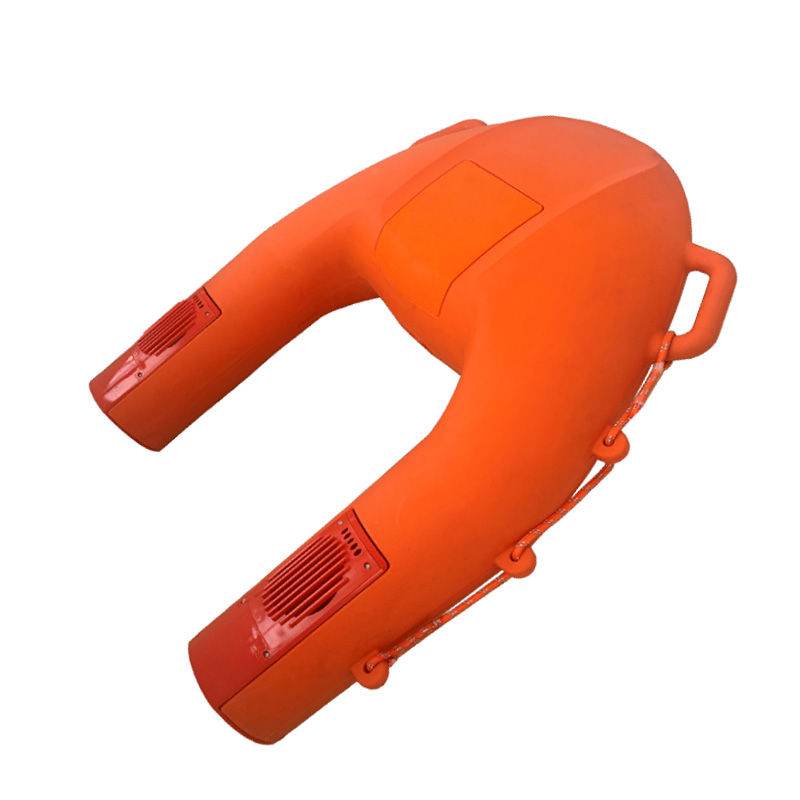
Remote Controlled Lifebuoy is a U-shaped remotely controlled water rescue wing with a control range of up to 1500 meters. It features dual-sided travel, one-button return, automatic righting, and precise positioning, enabling rapid arrival at the location of a person in the water. It is suitable for rescues in complex waters.
Remote Controlled Lifebuoy, also known as a water rescue wing, is a powered lifesaving device controlled wirelessly and capable of quickly reaching a person in the water. This device aims to improve response speed and operational safety in open water rescues, effectively overcoming the limitations of traditional throwable lifebuoys, such as limited distance and insufficient accuracy due to reliance on manual throwing. It provides rescuers with a remotely operable initial rescue method.
The core functionality of this device lies in its remote control performance and intelligent navigation capabilities. Its control range typically reaches 1500 meters, allowing operators to remotely control the device from shore, boat, or helicopter. The device supports dual-sided travel, including forward, backward, and turning, enabling flexible course adjustments. The integrated one-key return-to-home function allows the device to automatically return to its starting point; in the event of an unexpected wireless signal interruption, the return-to-home function is activated to prevent the device from being lost. The device's built-in positioning module (such as GPS) enables precise location tracking, facilitating its position in wide waters. An automatic righting design ensures the device can recover its normal floating posture after capsizing in waves. These features collectively ensure reliability in harsh weather and complex water conditions.
Structurally and in terms of propulsion, the device typically features a U-shaped or similar streamlined design, creating a central space to accommodate or allow a person falling into the water to grab onto. The shell is made of high-buoyancy materials and provides sufficient load-bearing capacity. Internally, the device houses a sealed power control system, a high-capacity battery, and one or more waterproof propulsion devices (usually a jet pump or propeller). This propulsion system allows it to travel at a significantly higher speed than human swimming or traditional lifebuoy drifting, enabling it to reach the target area much faster. The high-capacity battery ensures sufficient operating time.
In practical rescue applications, when a person falls into the water, rescuers deploy the Remote Controlled Lifebuoy into the water and then use a handheld remote control to guide it at high speed towards the person. Operators can navigate using visual guidance or by combining the device's location information with their own. Once the device approaches, the person can grab onto the sides or center of the U-shaped structure, allowing it to float on the surface. The operator can then remotely control the device to tow the person back to safety or keep them stable for further rescue, providing immediate buoyancy support and buying time for subsequent rescue efforts while reducing the risk of rescuers entering the water directly.
This device is suitable for various water rescue scenarios, including but not limited to coastlines, lakes, reservoirs, rivers, flood-stricken areas, and water activity venues. It can be used for rescue missions involving people falling into the water in fields such as fire rescue, maritime search and rescue, flood control emergency response, and scenic area safety management.
Therefore, the Remote Controlled Lifebuoy revolutionizes traditional water rescue methods by integrating remote wireless control, powered propulsion, and intelligent navigation algorithms. It transfers some of the rescuer's operations to remote locations, improving response speed and operational range, while reducing the risks to rescuers in dangerous environments such as rapids, waves, and low temperatures, making it an important piece of technical equipment in modern water emergency rescue systems.
The rain and water conditions refer to the changes in hydrological elements such as rainfall, river and reservoir water levels, and flow rates within a region. They serve as important bases for flood control and disaster reduction as well as water resource management. Measuring the rain and water co...
The Weather Station Monitoring System is an important component of the overall environmental monitoring system. It is mainly used for real-time and continuous monitoring and data collection of various meteorological elements and related pollutants in the atmospheric environment, providing scientific...
In a tea plantation base, there is an Agricultural Weather Stations for the tea garden microclimate. Composed of devices such as cameras, digital displays, and smart agricultural monitoring sensors, it serves as the "smart brain" of the tea garden.The core, Agricultural Weather Stations, c...
Ultrasonic Smart Weather Station integrates multi-element monitoring and uses a fully digital design to achieve accurate perception and real-time transmission of environmental data...


 Skype
Skype
 whatsapp
 mail
mail