Tianyi Sensor IOT Technology Co., Ltd
Sales Manager:Ms. Emily Wang
Cel,Whatsapp,Wechat:+86 15898932201
Email:info@fengtutec.com
Add:No. 155 Optoelectronic Industry Accelerator, Gaoxin District, Weifang, Shandong, China


Sales Manager:Ms. Emily Wang
Cel,Whatsapp,Wechat:+86 15898932201
Email:info@fengtutec.com
Add:No. 155 Optoelectronic Industry Accelerator, Gaoxin District, Weifang, Shandong, China
time:2026-04-28 11:07:55 source:Weather Station viewed:83 time
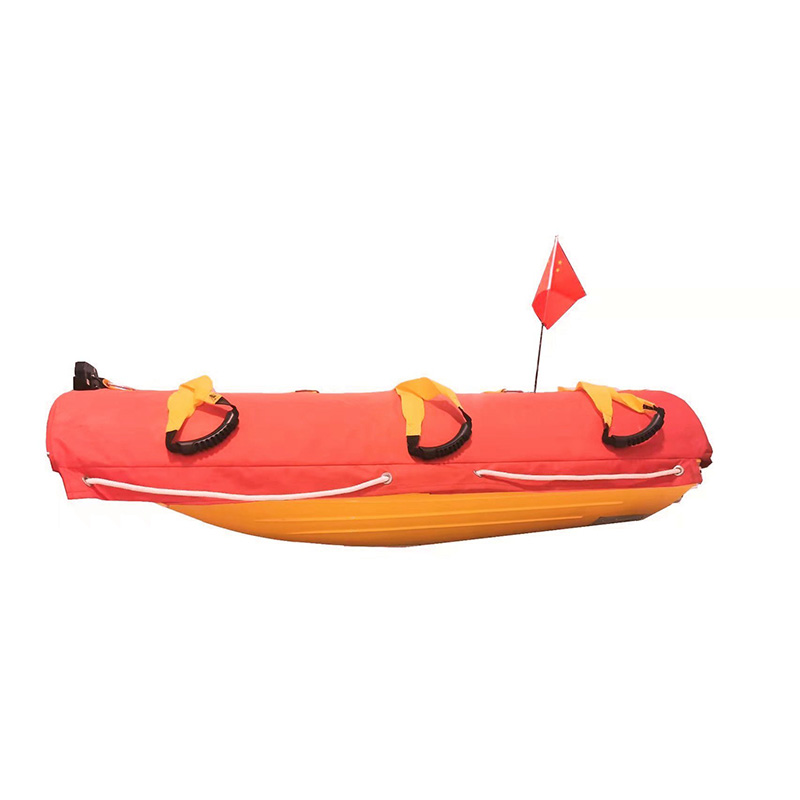
Water rescue robot is a novel, flat-panel, modular rescue device. It features a split-structure design—comprising an upper power module and a lower section made of soft, anti-collision buoyant material—and is capable of automatically righting itself if capsized. With a top speed of 48 km/h and a remote control range of 4,500 meters, it can simultaneously rescue 6 to 8 people in distress, serving as an efficient tool for the rapid rescue of drowning victims and the delivery of supplies.
Water rescue robot represents an intelligent, remote-controlled water rescue device that bridges the gap between traditional lifebuoys and full-scale rescue boats. Its flat-panel, split-structure design consists of an upper power module and a lower section constructed from soft, anti-collision buoyant material. The device is equipped with handles and tow ropes on both sides of its hull, allowing drowning victims to quickly spot and grasp it. In an emergency, rescuers need not enter the water; instead, they can remain in a safe zone—such as on the shore, on a boat, or in a helicopter—toss the device into the water, and use a remote controller to swiftly guide it to the victim's location. Once the victim has grasped the side handles or climbed onto the device, the operator uses the remote control to guide them back to safety. According to field test data, assuming a drowning victim is located 50 meters from shore, Water rescue robot can reach them in less than 9 seconds; in contrast, a human rescuer swimming to the same location would take approximately 50 seconds—making the device roughly 5.5 times faster.
In terms of technical specifications, Water rescue robot boasts a maximum speed of 48 km/h (unloaded), a maximum remote control range of 4,500 meters, an endurance of approximately 70 minutes, and a charging time of about 45 minutes. The complete unit weighs approximately 16 kg, holds an IP68 waterproof rating, generates 1,600 N of buoyancy, and is rated to withstand wave heights of up to 2 meters, allowing it to navigate stably through choppy waters. Its propulsion system utilizes a ducted jet design, enabling the device to automatically right itself within approximately one second if capsized. Furthermore, the device features real-time video transmission and remote lighting capabilities, and supports intelligent functions such as one-key return-to-home, automatic return upon signal loss, real-time heading display, and trajectory tracking—allowing for real-time remote command and control of the rescue operation from the shore. In terms of rescue capabilities, the Water rescue robot can simultaneously rescue 6 to 8 individuals who have fallen into the water; it can also be utilized to tow lifebuoys, inflatable boats, and floating ropes. Depending on the specific model, its towing force ranges from 200 kg to 400 kg, enabling it to effectively tow multiple adults. Compared to traditional rescue methods—which rely on rescuers physically entering the water or manually throwing lifebuoys and ropes—the Water rescue robot eliminates issues such as high physical exertion for rescuers, the difficulty of ensuring throwing accuracy, and the risk of the rescuer being pulled underwater by the drowning victim. It is deployed in a variety of scenarios, including flood relief operations, coastal patrols, reservoir inspections, urban flood management, and the rescue of individuals who have accidentally fallen into coastal waters. Rescuers are not required to make direct physical contact with the victim, thereby effectively safeguarding the rescuer's own safety. The device can be deployed from various platforms—including boats, shorelines, or helicopters—and serves as standard rescue equipment for government emergency agencies, water rescue organizations, swimming pool management authorities, and scenic area operators.
20km Portable Visibility Detector device employs the forward scattering method to calculate current atmospheric visibility by measuring the total extinction coefficient of the air. This equipment can be deployed on highways, mountain roads, and other similar locations to provide real-time visibility information, assisting traffic management departments in adjusting speed limits and issuing warnings. It is widely used in emergency response, road traffic, and meteorological monitoring....
Dust Monitoring Equipment is a critical environmental monitoring device explicitly required by environmental protection authorities. Its core monitoring parameters include PM2.5 and PM10, while it also concurrently monitors meteorological factors such as wind speed, wind direction, temperature, and...
The hand-held radar current meter works based on the Doppler effect principle. The radar probe of the instrument emits 24GHz microwave signals, which will be reflected when they hit the flowing water surface. Since the water surface is in a flowing state, the frequency of the reflected signals will...
Atmospheric Visibility Sensor is a meteorological monitoring device that calculates meteorological optical range (MOR) by measuring the intensity of light scattering from atmospheric particles. This article introduces a device that uses the forward scattering method, with a range of 2km and a...


 Skype
Skype
 whatsapp
 mail
mail