Tianyi Sensor IOT Technology Co., Ltd
Sales Manager:Ms. Emily Wang
Cel,Whatsapp,Wechat:+86 15898932201
Email:info@fengtutec.com
Add:No. 155 Optoelectronic Industry Accelerator, Gaoxin District, Weifang, Shandong, China


Sales Manager:Ms. Emily Wang
Cel,Whatsapp,Wechat:+86 15898932201
Email:info@fengtutec.com
Add:No. 155 Optoelectronic Industry Accelerator, Gaoxin District, Weifang, Shandong, China
time:2025-05-16 08:54:27 source:Weather Station viewed:336 time
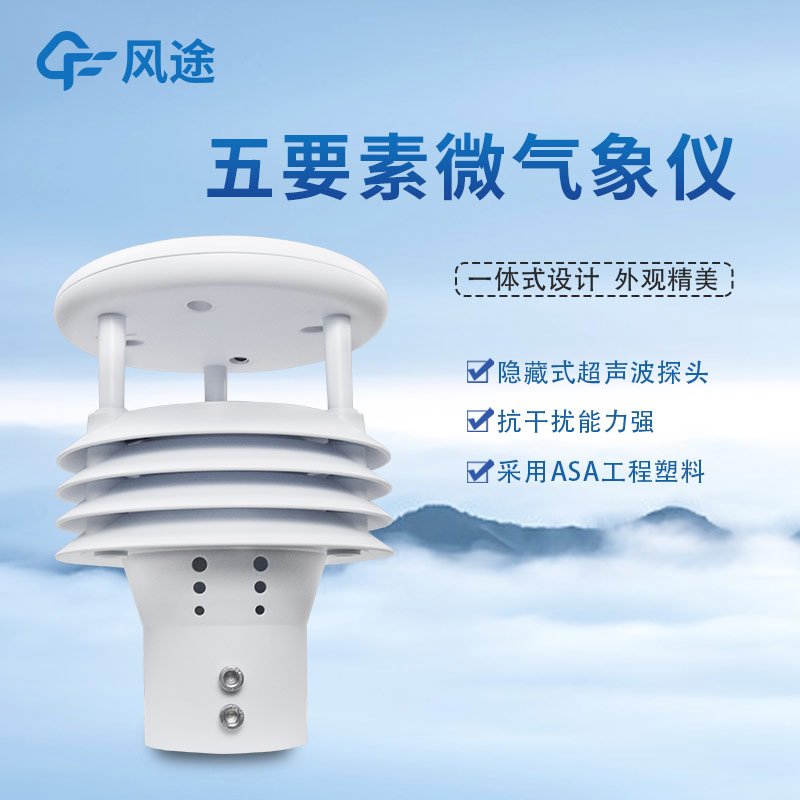
A miniature sensor is a highly integrated meteorological monitoring device. By integrating multiple miniaturized sensors and processing units, it can realize real-time monitoring and data collection of multiple meteorological elements. The device typically integrates core components such as temperature and humidity sensors, barometric pressure sensors, wind speed and direction sensors, etc., and can measure meteorological parameters such as ambient temperature, relative humidity, atmospheric pressure, wind speed, and wind direction. Some advanced models also have extended monitoring functions such as rainfall and light intensity. Its working principle is to use each sensor to convert physical meteorological parameters into electrical signals. After circuit processing, the data is sent to the terminal for analysis and storage through wireless or wired transmission methods.
Ordinary sensors have single functions and can only measure a single meteorological element. If it is necessary to obtain multiple meteorological data, multiple different types of sensors need to be deployed; while miniature sensors achieve multi-parameter integrated measurement, and one device can replace multiple ordinary sensors.
Portability and ease of installation are also important differences between the two. Ordinary sensors are large in size and heavy in weight, requiring professional equipment and venues for installation; miniature sensors can be flexibly installed in various scenarios, and can be quickly deployed and used in urban buildings, field monitoring points, or mobile monitoring platforms. Ordinary sensors lack data processing and transmission functions and require external complex data acquisition systems; miniature sensors have built-in data processing modules and communication modules, which can directly transmit data to the cloud or local servers, realize real-time data sharing and remote monitoring, and provide more efficient technical support for meteorological monitoring and early warning.
Entering the high - standard farmland demonstration area, 25 newly installed Solar insecticidal lamps are neatly arranged in the fields. These devices consist of silver lamp poles, black solar panels, and green lamp housings. They absorb solar energy and store electricity during the day, and at nigh...
Handheld weather stations provide convenience for people to obtain meteorological data anytime and anywhere. Among them, mechanical handheld weather stations and ultrasonic handheld weather stations are two common types. What are the differences between them? How should consumers choose?Differences...
The optical rain gauge employs a three-channel narrowband infrared detector and a pure sinusoidal AC signal source, offering a rainfall resolution of 0.01 mm and a rainfall intensity range of 0 to 4 mm/min. It boasts a measurement accuracy of ≤±4%, strong resistance to ambient light interfer...
Traditional flow measurement involves trekking through mountains and rivers, enduring sun and rain, while modern technology can achieve fully automatic monitoring with just one device.River flow measurement is a crucial part of water conservancy work, directly related to flood control, drought relie...


 Skype
Skype
 whatsapp
 mail
mail