Tianyi Sensor IOT Technology Co., Ltd
Sales Manager:Ms. Emily Wang
Cel,Whatsapp,Wechat:+86 15898932201
Email:info@fengtutec.com
Add:No. 155 Optoelectronic Industry Accelerator, Gaoxin District, Weifang, Shandong, China


Sales Manager:Ms. Emily Wang
Cel,Whatsapp,Wechat:+86 15898932201
Email:info@fengtutec.com
Add:No. 155 Optoelectronic Industry Accelerator, Gaoxin District, Weifang, Shandong, China
time:2026-04-15 11:12:15 source:Weather Station viewed:144 time
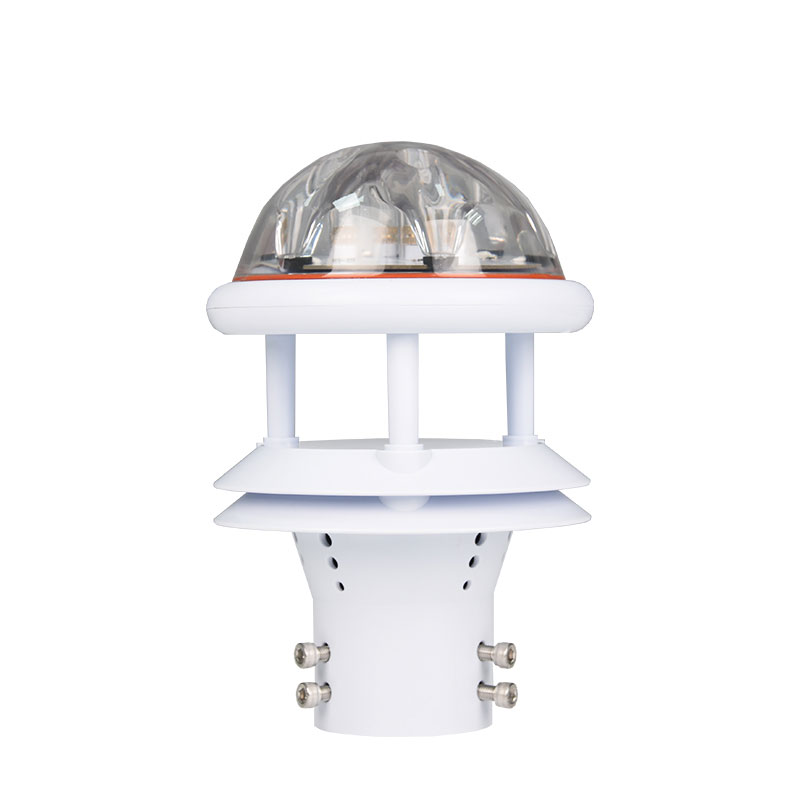
The optical rain gauge employs a three-channel narrowband infrared detector and a pure sinusoidal AC signal source, offering a rainfall resolution of 0.01 mm and a rainfall intensity range of 0 to 4 mm/min. It boasts a measurement accuracy of ≤±4%, strong resistance to ambient light interference, and requires no maintenance.
The optical rain gauge is a meteorological observation device that achieves precise rainfall measurement based on optical principles. It is widely utilized in meteorological stations, hydrological monitoring sites, agricultural parks, and urban flood control systems. Its core operating mechanism involves detecting the degree of attenuation experienced by light as it propagates through the air, thereby quantifying and determining the amount of rainfall occurring within a specific time interval. Compared to traditional mechanical rain gauges, the optical rain gauge offers distinct advantages such as rapid response times, non-contact measurement, and superior environmental adaptability, positioning it as a promising successor to conventional rain-measuring instruments.
In terms of technical design, the optical rain gauge incorporates a three-channel narrowband infrared detector and a pure sinusoidal AC signal source, delivering high precision, robust resistance to ambient light, maintenance-free operation, and compatibility with other optical sensors. The device features a built-in pure sinusoidal infrared light source and narrowband optical filters; with a rain-sensing surface area of 78 square centimeters, it can measure rainfall with high accuracy, remaining unaffected by intense light sources such as direct sunlight. Its high-transmittance rain-sensing cover allows direct sunlight to pass through unimpeded, enabling compatibility with other integrated optical sensors—such as those for illuminance, total radiation, and ultraviolet (UV) light.
The optical rain gauge operates by emitting an infrared beam and detecting the scattered light signals generated as raindrops pass through it. By applying intelligent algorithms to analyze variations in light intensity, the device calculates rainfall intensity and cumulative rainfall volume in real time. The unit features a fully sealed, dustproof, and waterproof structural design, making it resilient to harsh environmental conditions involving high temperatures, high humidity, and blowing sand or dust. It includes a built-in self-cleaning function to minimize interference from impurities, supports multiple data transmission protocols, and can be seamlessly integrated into existing meteorological monitoring systems.
Regarding technical specifications, the optical rain gauge operates on a supply voltage of DC 12V, with a sensor power consumption of 0.12 W and a current draw of 10 mA. It offers a rainfall resolution of 0.01 mm, a rainfall intensity range of 0 to 4 mm/min, and a measurement accuracy of ≤±4%. The device is designed to operate within an ambient temperature range of -40°C to 85°C and a relative humidity range of 0% to 100% RH. The device features a low-power design, making it suitable for use in unattended field observation stations.
During the installation and operation of the optical rain gauge, the following precautions should be observed: the area within a 1-meter radius surrounding the sensor must remain free of obstructions to prevent interference from splashing raindrops; the installation site should be clear of overhead tree cover, and the sensor's tilted orientation must also be kept free of tree shade; furthermore, to ensure measurement accuracy, the sensor must be installed in a perfectly horizontal position. This device is widely applicable across fields such as meteorological monitoring, flood warning systems, agricultural management, traffic safety support, and hydrological research, providing reliable technical support for urban flood control, agricultural irrigation, and traffic meteorology.
The Portable Visibility Monitor employs the forward scattering method to measure the total extinction coefficient of the air, offering a visibility range of up to 20 kilometers with a resolution of 1 meter. Compact and lightweight, the device is ready for immediate use upon power-up. It is wid...
You may not know that the occurrence and spread of many plant diseases are related to pathogenic spores. Spores are the reproductive units of fungal pathogens, which are tiny in size and numerous in quantity. They can be widely transmitted through media such as wind, rain, and insects. Once spores l...
Laser methane telemeter, leveraging laser technology, is used to detect the concentration of methane gas in the environment and has been widely applied in natural gas stations, the petroleum and petrochemical industry, the metallurgical industry, the power industry and other places.According to diff...
Present weather and visibility sensor is a professional meteorological observation device based on the forward scattering principle. It calculates real-time visibility by measuring the total extinction coefficient of the air, enabling automated identification and recording of weather phenomena...


 Skype
Skype
 whatsapp
 mail
mail