Tianyi Sensor IOT Technology Co., Ltd
Sales Manager:Ms. Emily Wang
Cel,Whatsapp,Wechat:+86 15898932201
Email:info@fengtutec.com
Add:No. 155 Optoelectronic Industry Accelerator, Gaoxin District, Weifang, Shandong, China


Sales Manager:Ms. Emily Wang
Cel,Whatsapp,Wechat:+86 15898932201
Email:info@fengtutec.com
Add:No. 155 Optoelectronic Industry Accelerator, Gaoxin District, Weifang, Shandong, China
time:2025-06-06 08:52:01 source:Weather Station viewed:377 time
A meteorological observation station is a facility used to monitor and record meteorological information. It collects data on weather conditions through various instruments and equipment, providing important basis for weather forecasting, climate research and disaster warning.
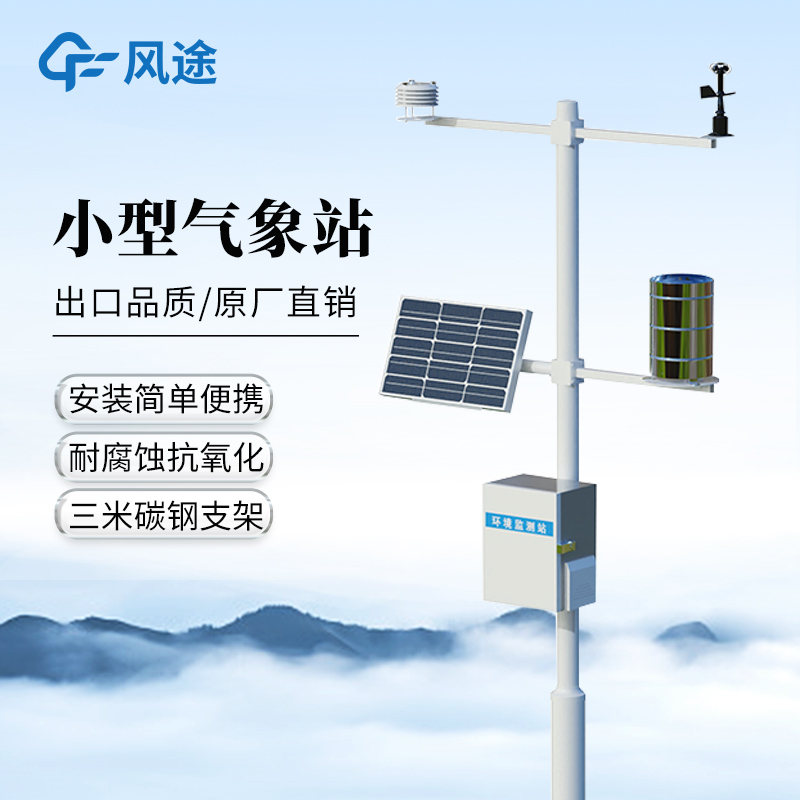
As a professional facility for comprehensive observation of meteorological elements, its system architecture consists of two major components: hardware and software. At the hardware level, sensors are the basic equipment for acquiring meteorological data. For example, thermocouple temperature sensors can convert heat fluctuations into electrical signals to accurately measure air temperature; tipping bucket rain gauges can count the number of tip bucket tilts to realize the statistics of rainfall. The data collector plays a central role in the system, collecting, processing and storing the signals output by the sensors. The power supply mostly adopts the mode of solar panels with storage batteries to ensure stable power supply. Communication equipment can use wireless transmission methods such as GPRS and satellites, or wired transmission channels such as optical fibers to realize the real-time transmission of data to the meteorological center. Protective devices such as wind-proof and corrosion-resistant metal brackets and lightning protection systems ensure the normal operation of hardware equipment under complex meteorological conditions.
The acquisition software is responsible for real-time calibration and storage of sensor data. The business software collates the raw data into reports and charts for easy analysis, and supports remote equipment management. The data analysis and prediction software uses algorithm models to conduct in-depth analysis of historical meteorological data, and then predicts the trend of weather evolution, providing strong data support for meteorological forecasting, disaster prevention and other work.
The role of meteorological observation stations is mainly reflected in three aspects. First, it is the basic data source for weather forecasting. Based on the data of air temperature, humidity, air pressure, wind direction and wind speed collected by the meteorological station, meteorologists use meteorological principles and computer models to analyze the movement of the atmosphere and predict future weather conditions. For example, if a meteorological station records a continuous drop in air pressure, combined with changes in other meteorological elements, it may indicate the approach of a rainstorm or storm. Second, meteorological stations are key facilities for climate research. Long-term observation data from meteorological stations are irreplaceable for studying climate change. Through decades or even centuries of data accumulation from meteorological stations, scientists can analyze the changing trends of climate elements such as temperature and precipitation, and understand the evolution laws of the climate system. Finally, meteorological stations can monitor extreme weather events in real time and provide a strong support for disaster warning. When severe weather such as rainstorms, strong winds and typhoons occurs, the monitoring data of meteorological stations can be timely fed back to the meteorological department, which will issue disaster warning information accordingly to remind people to take preventive measures and reduce disaster losses.
Meteorological stations are generally established in open and representative locations to ensure that the collected data can truly reflect the local atmospheric conditions. Their layout will take into account avoiding the interference of surrounding tall buildings, trees and other factors on the observation data. According to different observation needs and geographical conditions, they are divided into many types, such as urban meteorological stations, mountain meteorological stations and marine meteorological stations.
Water Rescue Equipment refers to a remotely controlled lifebuoy. Controlled wirelessly, it is powered by four ducted propulsion units, achieving an unloaded speed of 27 km/h. It supports one-key return and automatic return upon loss of contact, making it suitable for rescue operations in river...
Here's a little bit of knowledge: Bridges actually freeze more easily than road surfaces.Why is that?From the perspective of heat dissipation, the temperature difference between a bridge deck and an ordinary road surface is quite understandable. The road surface is directly built on the ground,...
An ultrasonic weather station is a highly integrated meteorological monitoring device that utilizes modern ultrasonic detection technology. It emits ultrasonic waves and measures changes in their propagation speed through the air to accurately calculate wind speed and direction, completely eliminati...
In today's society, with the acceleration of the processes of industrialization and urbanization, air quality issues have received increasing attention from people. There is a wide variety of pollutants in the air. Among them, the "four gases" (carbon monoxide, sulfur dioxide, nitrogen...


 Skype
Skype
 whatsapp
 mail
mail