Tianyi Sensor IOT Technology Co., Ltd
Sales Manager:Ms. Emily Wang
Cel,Whatsapp,Wechat:+86 15898932201
Email:info@fengtutec.com
Add:No. 155 Optoelectronic Industry Accelerator, Gaoxin District, Weifang, Shandong, China


Sales Manager:Ms. Emily Wang
Cel,Whatsapp,Wechat:+86 15898932201
Email:info@fengtutec.com
Add:No. 155 Optoelectronic Industry Accelerator, Gaoxin District, Weifang, Shandong, China
time:2025-09-11 09:01:00 source:Weather Station viewed:354 time
As the impacts of climate change continue to intensify, the frequency and destructive scale of flood disasters are on the rise, posing severe threats to public safety and socio-economic development. Summer is inherently a high-risk period for disasters such as floods and droughts. To further enhance disaster prevention and mitigation capabilities and effectively safeguard the lives and property of the public, on-site installation of professional monitoring equipment has become a necessary measure, and the Fengtu Water Level Monitoring System stands out as an ideal choice for this purpose.
The Fengtu Water Level Monitoring System mainly consists of two core components: the hydrological and rainfall monitoring station on the hardware side, and the environmental monitoring cloud platform on the software side. Leveraging intelligent sensing and data analysis technologies, this system can collect real-time hydrological parameters, issue timely early warnings for risk situations, and realize collaborative linkage in emergency responses. These functions directly improve the safety assurance level of water conservancy infrastructure and play a crucial role in reducing flood disaster risks.
Water level, flow rate, and rainfall are the core parameters for the operation and dispatching of water conservancy projects. Their accuracy directly determines whether the reservoir storage and discharge decisions are scientific, whether flood early warnings are timely, and whether water resource allocation is reasonable. The water level gauges and flow meters equipped with the Fengtu Water Level Monitoring System all adopt the radar measurement principle — there is no need to dig channels or have the equipment come into contact with water, fundamentally avoiding equipment corrosion caused by sedimentation. It is worth noting that traditional contact electrodes require cleaning 2-3 times a year, while radar-based ones require no such maintenance at all, thus effectively ensuring measurement accuracy.
Compared with the common ultrasonic water level and flow meters on the market, the radar water level/flow meters of the Fengtu Water Level Monitoring System have significantly stronger environmental adaptability. The radar waves it emits can penetrate interferences such as heavy rain, fog, and steam. Unlike traditional ultrasonic measurement, which has an error of ±5% in heavy rainfall conditions; even in extreme scenarios such as frozen rivers at -40°C or turbulent floodwaters, the radar-based meters can still stably maintain millimeter-level measurement accuracy. This equipment also has a wide range of applications — it can not only meet the monitoring needs of small-flow rivers but also be competent in the monitoring work of large reservoirs, providing reliable support for water conservancy monitoring in different scenarios.
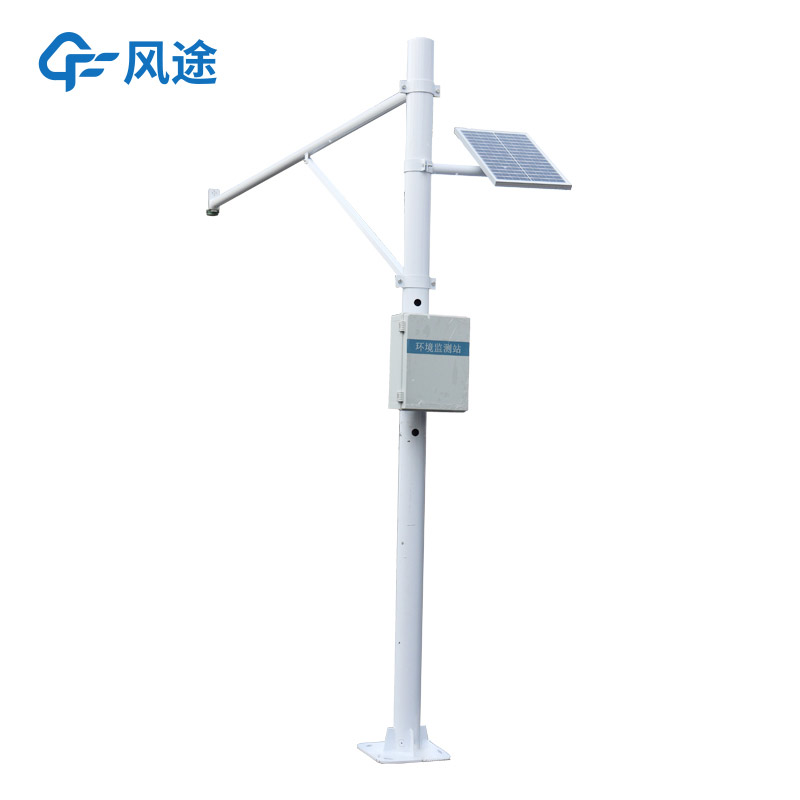
In today's society, environmental issues are receiving increasing attention, and air quality has become an important factor affecting people's quality of life. As one of the key pollutants impacting air quality, dust is in urgent need of accurate monitoring and effective control. The Dust De...
The Single Rain Gauge Monitoring Station consists of a stainless steel rain sensor, a data collector, a solar power supply system, and a pole-mounted bracket. It wirelessly transmits rainfall data to a remote monitoring platform, supporting statistical analysis—such as daily and monthly rainf...
The Wind Sensor employs the time-of-flight measurement principle, accurately calculating wind speed and direction by detecting changes in the speed of ultrasonic waves propagating in the air....
To meet the needs of air pollution prevention and control, environmental protection authorities require more refined and efficient air quality supervision. However, traditional national standard monitoring stations, despite providing high data accuracy, face limitations such as high construction cos...


 Skype
Skype
 whatsapp
 mail
mail