Tianyi Sensor IOT Technology Co., Ltd
Sales Manager:Ms. Emily Wang
Cel,Whatsapp,Wechat:+86 15898932201
Email:info@fengtutec.com
Add:No. 155 Optoelectronic Industry Accelerator, Gaoxin District, Weifang, Shandong, China


Sales Manager:Ms. Emily Wang
Cel,Whatsapp,Wechat:+86 15898932201
Email:info@fengtutec.com
Add:No. 155 Optoelectronic Industry Accelerator, Gaoxin District, Weifang, Shandong, China
time:2025-07-21 08:48:26 source:Weather Station viewed:355 time
In terms of application value, the popularization of integrated dust monitoring sensors like the FT-WQX8 is transforming traditional environmental monitoring models. In the past, single-parameter monitoring devices required separate deployment and maintenance. Not only did this result in high initial equipment procurement costs, but the scattered nature of the devices also demanded more human and material resources in long-term operation and maintenance. Additionally, differences in data collection time and accuracy among different devices led to prominent issues of data asynchronization. However, by integrating multiple monitoring functions, this sensor can complete multi-parameter monitoring with a single device, reducing installation costs during deployment and later operation and maintenance costs. Meanwhile, since all parameters are collected synchronously, it makes the correlation analysis between dust pollution and meteorological conditions more convenient and the results more accurate.
In actual supervision, these real-time monitoring data can provide precise basis for environmental law enforcement. For example, if the PM10 concentration in a construction site exceeds the standard and the wind speed is low, combined with humidity data, if the air is dry, it can be judged that the site's sprinkling and dust suppression measures are insufficient; if the humidity is normal but the concentration in the area with fixed wind direction is relatively high, it may be that the unreasonable setting of enclosures causes dust spillage. Supervision departments can quickly identify the root cause of the problem based on this and promptly require rectification. The long-term accumulated monitoring data can also provide references for urban dust pollution control planning. By analyzing the correlation between dust concentration changes in different regions and seasons and meteorological factors, it helps identify high-pollution areas and periods. For instance, areas with concentrated construction sites are prone to dust peaks in spring with strong winds. Thus, more targeted control strategies can be formulated, such as increasing inspection frequency during key periods and requiring construction units to strengthen windproof and dust suppression measures, so as to reduce dust emissions from the source.
From the perspective of technical adaptability, the digital output characteristic of the sensor enables it to be easily connected to urban environmental monitoring platforms, realizing real-time data transmission and sharing. Different entities such as environmental protection departments, construction units, and scientific research institutions can obtain required data through the platform: environmental protection departments use it for supervision and law enforcement, construction units for self-inspection and rectification, and scientific research institutions can carry out research on the formation mechanism of dust pollution based on a large amount of data, promoting the upgrading and iteration of governance technologies, and forming a multi-party collaborative pattern for dust pollution control.
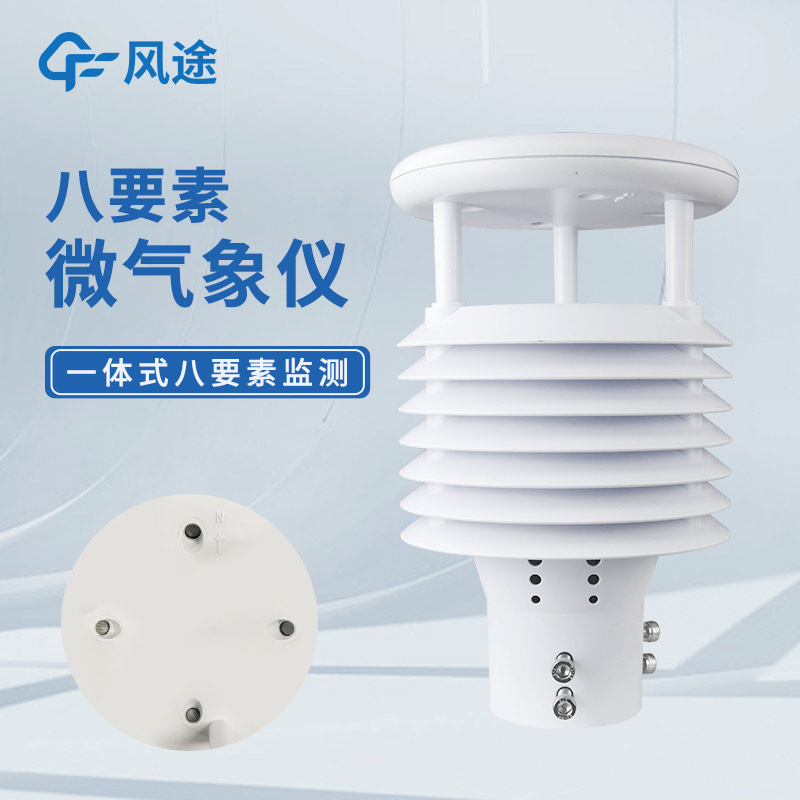
3D Ultrasonic Anemometer can measure the horizontal and vertical wind speed and direction values in three-dimensional space at high frequency, providing accurate and real-time data support for various industries.The working principle of this sensor is based on the propagation characteristics of ultr...
Atmospheric Visibility Sensor is a meteorological monitoring device that calculates meteorological optical range (MOR) by measuring the intensity of light scattering from atmospheric particles. This article introduces a device that uses the forward scattering method, with a range of 2km and a...
The FT-WQX6 Micro Weather Sensor is a multi-functional automatic weather station developed by our company, leveraging years of experience in meteorological product development and addressing practical on-site application requirements. It directly integrates six key meteorological elements: temperatu...
Visibility and Present Weather Sensor uses the forward scattering method to measure the total extinction coefficient of air, calculate visibility, and identify weather phenomena such as fog, rain, and snow, with a recognition rate of ≥95%. The casing is made of anodized aluminum, making the e...


 Skype
Skype
 whatsapp
 mail
mail