Tianyi Sensor IOT Technology Co., Ltd
Sales Manager:Ms. Emily Wang
Cel,Whatsapp,Wechat:+86 15898932201
Email:info@fengtutec.com
Add:No. 155 Optoelectronic Industry Accelerator, Gaoxin District, Weifang, Shandong, China


Sales Manager:Ms. Emily Wang
Cel,Whatsapp,Wechat:+86 15898932201
Email:info@fengtutec.com
Add:No. 155 Optoelectronic Industry Accelerator, Gaoxin District, Weifang, Shandong, China
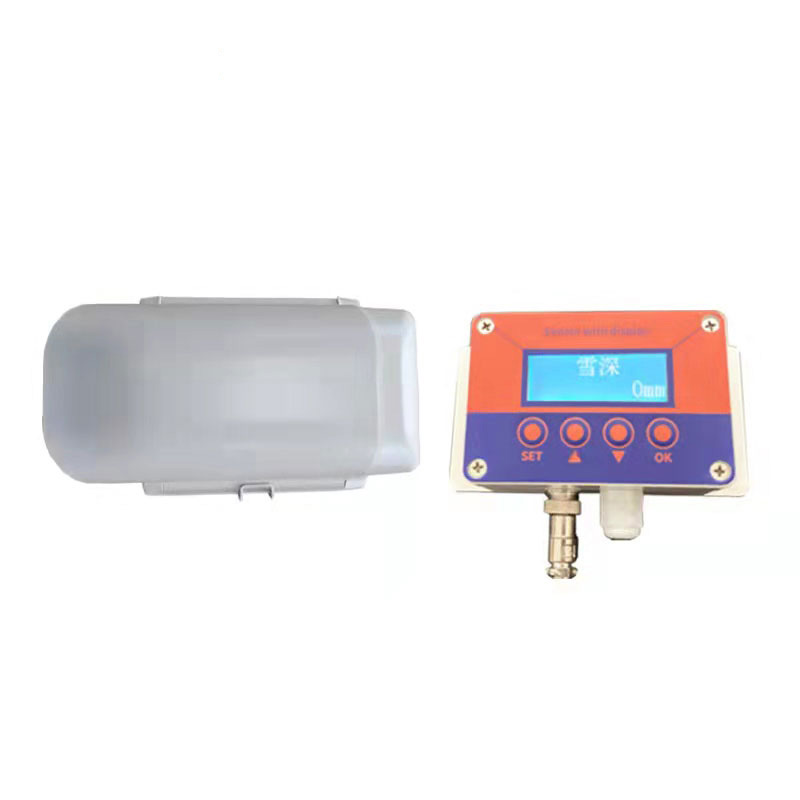
Model:FT-JX2
Brand:tianyi
1.Overview of Snow Depth Sensor
Snow Depth Sensor uses visible laser measurement technology with millimeter-level accuracy for precise, continuous and non-contact recording of snow depth.Water is the foundation of the existence of various creatures on the earth.The changes and movement of water have created our world today.Snowfall is an important part of the water cycle.Snowfall has a certain impact on the balanced development of the ecological environment and people's lives and production.
Automatic snow depth monitoring station is a professional equipment for real-time monitoring of snowfall information based on years of experience in manufacturing meteorological and environmental instruments.The equipment uses laser recognition and measurement technology to overcome ultrasonic waves, electromagnetic waves, weight and other types.The sensor cannot recognize the disadvantages of snow, thus achieving extremely high detection accuracy.By monitoring the distance at the location, the thickness of the snow is obtained and the snowfall per unit time is analyzed.This device can be an independent automatic snow depth monitoring alarm system, or it can be networked to form a diversified network monitoring.
Application scope: Widely used in many fields such as meteorological stations, port terminal safety monitoring, road traffic safety monitoring, aviation monitoring, building safety monitoring, agricultural production monitoring, hydrology and water conservancy.
2.Snow Depth Sensor laser ranging principle
The snow depth sensor uses the principle of a phase laser rangefinder to measure the depth of snow.The phase is the frequency of the radio band.The laser rangefinder is used to modulate the laser beam amplitude and measure the phase delay generated by the modulated light round-trip measurement line once, and then according to The wavelength of the modulated light is converted to the distance represented by this phase delay.That is, the time required for light to pass through the round-trip measurement line is determined by indirect method, thereby solving the depth of snow.
3.Snow Depth Sensor Technical Parameters
| powered by | DC12-15V | |
| Measurement range | 0.05~5m | |
| Measurement accuracy (standard deviation) | ±1.0mm | |
| Signal output | RS485 | |
| Distance unit | m | |
| Laser Type | 620~690nm | |
| Laser grade | Level II, <1mW | |
| Spot diameter at distance m | 6mm@10m, 30mm@50m | |
| Single measurement time | 0.05~1s | |
| Protection level | IP65 | |
| Operating temperature | -40~+50℃ | |
| Storage temperature | -20~+80℃ | |
| weight | ||
| Dimensions (Length × Width × Height) | ||
| Implementation standards | GB/T 14267-2009 | |
| Power consumption | standard | 0.9W |
| heating | 14W | |
| Heating method | Automatic temperature control | |
Remark:
For different measurement targets and measurement environments, due to the excessive intensity of the ambient light, the ambient temperature is too high or too low, the target reflection is too weak or too strong, or the target surface is rough and uneven, the measurement range may be shortened or the measurement results may be caused.Large error.
How it works:
Measurement method:
After first installing or moving the installation position, you need to adjust the zero.Press "SET" for 5 seconds to complete the zeroing.
The working principle of the sensor: data is collected once in 10 minutes if there is snow (snow depth is greater than 10mm) and data is collected once in 30 minutes if there is snow.
Intra-cavity heating time: When the temperature in the cavity is lower than 0 degrees, turn on the heating mode and heat it for 5 minutes each time.
To meet the needs of air pollution prevention and control, environmental protection authorities require more refined and efficient air quality supervision. However, traditional national standard monitoring stations, despite providing high data accuracy, face limitations such as high construction cos...
The growth of crops is closely linked to soil conditions. Harnessing the "advantages of the land" and carrying out crop cultivation in line with local conditions are core measures to increase crop yields. In agricultural production, links such as the selection of spring sowing timing, dete...
River Level Monitoring Station is one of the tools in the modern flood control and disaster reduction system. It realizes real-time control of watershed hydrological information through multi-dimensional data collection and intelligent analysis. The system is composed of four major modules: water le...
Before the advent of ultrasonic anemometers, traditional wind speed and direction measurements mainly relied on mechanical sensors.Cup anemometers calculate wind speed through wind force pushing three or four hemispherical cups to rotate, with rotational speed proportional to wind speed.Wind vanes,...


 Get a Free Quote
 Skype
Skype
 whatsapp
 mail
mail