Tianyi Sensor IOT Technology Co., Ltd
Sales Manager:Ms. Emily Wang
Cel,Whatsapp,Wechat:+86 15898932201
Email:info@fengtutec.com
Add:No. 155 Optoelectronic Industry Accelerator, Gaoxin District, Weifang, Shandong, China


Sales Manager:Ms. Emily Wang
Cel,Whatsapp,Wechat:+86 15898932201
Email:info@fengtutec.com
Add:No. 155 Optoelectronic Industry Accelerator, Gaoxin District, Weifang, Shandong, China
time:2025-05-20 09:45:50 source:Weather Station viewed:483 time
Ports serve as critical hubs connecting the ocean and land, with numerous vessels entering/exiting and cargo being loaded/unloaded daily. However, due to their unique geographic locations, ports face complex and variable meteorological conditions. Among these, wind speed and direction significantly impact port operation safety and efficiency. For example, when wind force reaches Beaufort scale 6 or above, many cargo ships cannot berth for operations, and portal crane operations face a higher risk of collisions. Therefore, ports need to monitor wind speed and direction information.
How is wind speed and direction measured? Common methods include mechanical and ultrasonic approaches.
Mechanical monitoring instruments such as cup anemometers and vane wind direction sensors:
Cup anemometers consist of empty cups fixed on a bracket. When wind blows the cups, they drive a rotating shaft to measure wind speed.
Vane wind direction sensors use a wind vane: when wind blows against the tail fin, the arrow points to the wind’s incoming direction to determine wind direction.
Drawbacks: Mechanical wear over time reduces measurement accuracy, and they cannot accurately measure high-frequency components of gust pulses.
Ultrasonic Wind Speed Direction Sensors measure wind speed and direction by leveraging the influence of air flow (wind) on the propagation speed of ultrasonic waves. The principle is based on changes in ultrasonic propagation speed under different wind speeds. When ultrasonic waves are transmitted from one point to another, wind along the path accelerates waves moving with the wind and decelerates those moving against it. By precisely measuring the time difference of wave propagation in different directions, wind speed and direction can be calculated. Compared to mechanical anemometers, ultrasonic sensors for wind speed and direction offer advantages such as:
No mechanical moving parts, eliminating friction from rotating shafts.
Accurate measurement of high-frequency components in gusts.
Inertia-free measurement.
Strong corrosion resistance, long service life, and low maintenance costs.
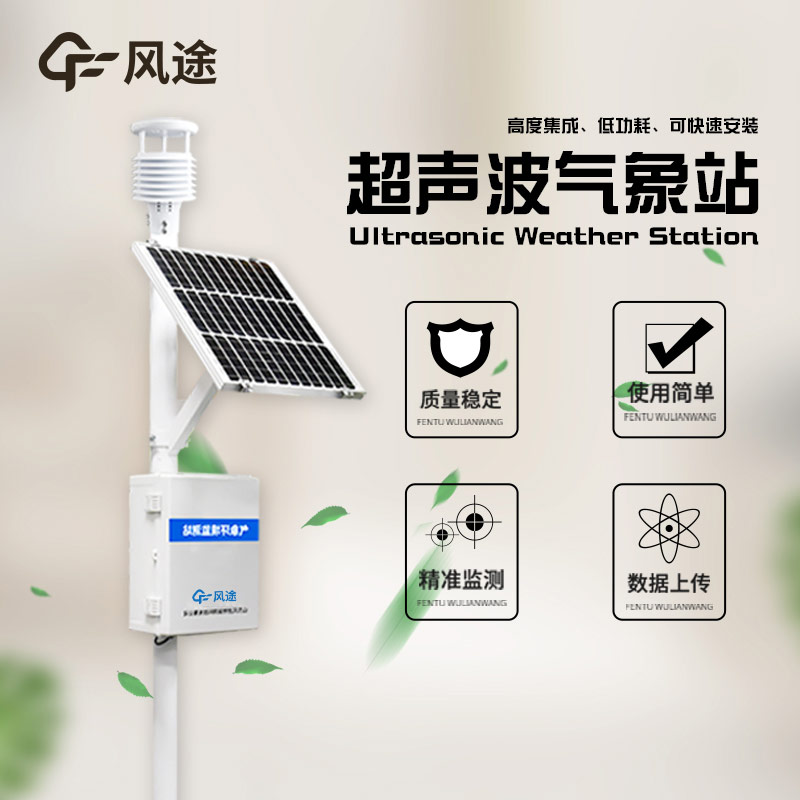
The FT-CQX2 Wind Speed Monitoring System is a rapidly deployable device widely used in meteorology, agriculture, forestry, environmental protection, marine affairs, airports, ports, scientific research, and education. It uses a two-element integrated sensor to real-timely observe wind speed, wind direction, and other meteorological factors, enabling 24-hour continuous online monitoring of outdoor meteorological parameters. Both parameters are output simultaneously to users via a digital communication interface.
Design Features:
Hidden ultrasonic probes in the top cover prevent interference from snow/rain accumulation and natural wind obstruction.
The sensor housing is made of imported ASA material with an IP65+ protection rating, effectively resisting harsh environments like salt spray.
Currently, traditional environmental monitoring methods have some limitations: mainly point-based monitoring with scattered distribution, few online monitoring points, difficulty in accurately tracing pollution sources, and high cost of traditional air automatic monitoring stations. Therefore, the c...
I. Product IntroductionOur company is a professional manufacturer of meteorological sensors. We have been focusing on the research and development, as well as the production of various meteorological sensors, and also provide meteorological environment solutions. The company has a complete productio...
Compared with traditional embedded sensors, the Road Condition Sensor has obvious advantages in practical applications. It adopts non-intrusive installation, which does not require damaging the road structure. The installation process is simple and convenient, which can greatly reduce the impact of...
How to solve the problems of water pollution and water quality deterioration? Traditional manual sampling is time-consuming and lagging, but now there is a more efficient solution - the Water Quality Monitoring Buoy!As a key piece of equipment for water environment monitoring, its development precis...


 Skype
Skype
 whatsapp
 mail
mail